Physician Mortgage Guides

How to Relocate with a Physician Mortgage

DHF Icon

Dr. Home Finance

Female physician holding a box of her belongings, moving out of her office.

TLDR

Physician relocation is the norm, not the exception, and conventional mortgages are not designed for doctors who need to buy in a new state before their first paycheck arrives. A physician mortgage loan changes that equation entirely by allowing contract-based qualification up to 90 days before a start date.

  • Conventional loans require local pay stubs, in-state employment history, and occupancy within 60 days — barriers that directly disqualify most relocating physicians, especially residents, fellows, and new attendings moving between states.

  • Physician mortgage loans accept a signed employment contract as qualifying income, offer zero to 5% down with no PMI, and treat student loan debt more favorably in DTI calculations, making them the right tool for nearly every cross-state physician relocation.

  • Getting pre-approved before you move is both possible and strongly recommended — with a signed contract, government ID, credit report, and proof of funds, you can lock in financing from your current location and compete in your new market from day one.

  • Common mistakes to avoid include waiting too long to apply, using a generalist lender unfamiliar with physician income structures, skipping the home inspection, and underestimating relocation costs beyond the mortgage itself.

Why Relocation Creates Problems for Conventional Mortgages

Conventional conforming loans, backed by Fannie Mae or Freddie Mac, have strict guidelines that create specific problems for relocating physicians. To qualify under a conventional program when relocating, lenders typically require:

  • Pay stubs from the new job confirming that income has already started

  • W-2s or a written verification of employment with a confirmed start date that has passed

  • Physical occupancy or residency in the state where the home is located within 60 days of closing

  • Proof of licensure or eligibility to work in the new state

This creates a direct barrier for physicians who are just finishing training and have not started their new position, are in a transition period between employers, or are fully licensed but not yet working in the new state. The contract is signed. The income is real and documented. But conventional underwriting cannot use it until the income actually begins.

Physician mortgage programs bypass this by accepting a signed employment or residency contract as qualifying income, typically up to 90 days before the start date. That single feature changes the entire relocation timeline.

Why Physician Mortgage Loans Work for Relocation

Physician mortgage lenders understand that doctors do not follow a traditional employment path. The income is reliable. The career trajectory is clear. The documentation looks different from a conventional borrower, but the creditworthiness is strong.

The key features that make physician mortgage loans well-suited to cross-state relocation include:

  • Contract-based qualification: a signed employment or residency contract with a documented start date within 60 to 90 days of closing is accepted as proof of qualifying income

  • Zero to 5% down payment with no PMI, preserving liquidity during a relocation when moving costs, licensing fees, and transition expenses all compete for the same cash

  • Flexible student loan treatment in debt-to-income calculations, which is particularly important for physicians entering their first attending role with significant loan balances

  • Higher loan limits than standard conforming caps, allowing physicians to buy in markets where conforming limits do not reflect actual home values

The combination of these features means that a physician who has signed a contract for a new role in another state can often be pre-approved, under contract on a home, and closing well before their first shift. That eliminates the need for temporary housing, reduces double-move disruption, and lets a new physician settle in and focus on the job rather than the logistics of finding a place to live.

Getting Pre-Approved Before You Move

Getting pre-approved while still in your current state is not only possible, it is the recommended approach. Waiting until you arrive in a new city is one of the most common and costly mistakes relocating physicians make. Markets in physician relocation destinations move quickly, and starting the process early gives you the preparation and credibility to act decisively.

What You Will Typically Need

  • Signed employment or residency contract with a start date within 60 to 90 days of closing

  • Government-issued photo ID

  • Credit report (700 or higher is ideal; some programs accept 680 with compensating factors)

  • Proof of funds for down payment or reserves, even if pursuing a 0% down option

  • Letter of completion or verification of graduation for residents and fellows finishing training

You do not need to be licensed in the new state to begin the mortgage process. Most lenders will require that you be fully licensed by the time of closing, but the pre-approval and application can proceed before that milestone.

Common Physician Relocation Scenarios

Moving for Residency

A residency match letter or signed offer letter from your program is typically sufficient to qualify. You can begin the purchase process before your first shift, using the contract to establish qualifying income. This is one of the most impactful use cases for physician mortgage programs, as residents generally have limited savings and significant student loan balances that would disqualify them under conventional underwriting.

Starting a New Attending Role

For physicians transitioning from training to an attending position, physician mortgage programs use the contracted attending income rather than the training salary. This matters significantly because attending compensation can be two to three times residency income. Qualifying on the new contract income rather than the current income is one of the most direct financial advantages of the physician mortgage for this group.

Changing Jobs with a Short Employment Gap

Physician mortgage lenders may allow a gap of 30 to 60 days between the end of one role and the beginning of the next, and still approve a loan if the next position is under contract. This covers physicians who are finishing a fellowship or leaving one health system for another and need to close on a home before the new role officially begins.

Relocating with an Employment Contract but No Local History

Some physicians move to a new state where they have no prior income history, no prior rental history, and no established local banking relationships. Physician mortgage programs evaluate the contract and career profile rather than requiring local income documentation, making this scenario fully workable for most qualified borrowers.

What Changes When Buying Across State Lines

Physician mortgage programs are available in most states, but program details do vary. Before committing to a lender, confirm the following state-specific considerations:

  • Loan limits may differ by region. In high-cost markets, physician programs often allow higher loan amounts than standard conforming limits, but the specific tiers vary by lender and location.

  • Property type eligibility varies. Condominiums, multi-unit properties, and planned unit developments may have additional requirements that differ by state or lender.

  • Licensing timelines vary by state. Some states have faster reciprocity processes for physicians licensed elsewhere, and some lenders are more flexible about the timing of licensure relative to closing.

  • Underwriting guidelines can shift slightly depending on the lender and their familiarity with specific state markets. Working with a lender who has experience in your destination state is an advantage.

Confirm all state-specific details with your loan officer early in the process, before you are under contract on a property.

Remote Homebuying: No Longer the Exception

A physician relocating across the country does not need to make multiple expensive trips to tour homes before making a decision. Remote homebuying is now mainstream. According to the National Association of REALTORS 2024 Generational Trends Report, nearly one in four buyers under 40 purchased their home without ever touring it in person.

For relocating physicians, the infrastructure for fully remote homebuying is well-established. Most physician mortgage lenders and real estate partners now support the following:

  • Video walkthroughs with agents who know how to show a home effectively on camera

  • Digital document collection and e-signature platforms for the entire application and closing process

  • Remote online notarizations and remote closings in most states

  • Virtual pre-approval processes that can be completed entirely from your current location

The practical recommendation: do not wait until you arrive to begin your home search. Connect with a real estate agent in your new city early, use virtual tours to narrow your list, and lock in financing while you are still in your current role. DrHomeMatch can help you connect with physicians already in your target market so you can get honest neighborhood recommendations before you ever set foot in the city. In competitive markets, being fully pre-approved before you arrive gives you a meaningful advantage over buyers who are starting cold.

What to Do If You Are Unfamiliar with the New Market

Relocating to a state or city you have never lived in introduces a layer of uncertainty around neighborhood selection. Buying in the wrong location for your commute, lifestyle, or long-term plans is a more painful mistake than most relocation logistics. A few approaches that help:

  • Talk to colleagues, program coordinators, or hospital staff about where they live and what areas they recommend. Physicians who have been in the market for a year or two will have current, practical insight that online research cannot replicate. You can also use DrHomeMatch to connect with physicians already living and working in your destination city, getting real insight from doctors who have made the same move.

  • Ask your real estate agent about commute times to your hospital or practice location from multiple neighborhoods, not just the ones that look attractive on a map.

  • Prioritize proximity to work, grocery access, green space, and schools if applicable. Those factors drive day-to-day quality of life more than most other variables.

  • Consider renting temporarily if you are genuinely uncertain about the market. A short-term lease gives you time to experience the city before committing to a specific neighborhood. That peace of mind has real value, and it is a better choice than rushing into a home purchase in the wrong location.

If your situation genuinely warrants renting first, that is a reasonable and defensible choice. The physician mortgage is available when you are ready. There is no requirement to buy immediately.

Common Relocation Mistakes to Avoid

Waiting Too Long to Apply

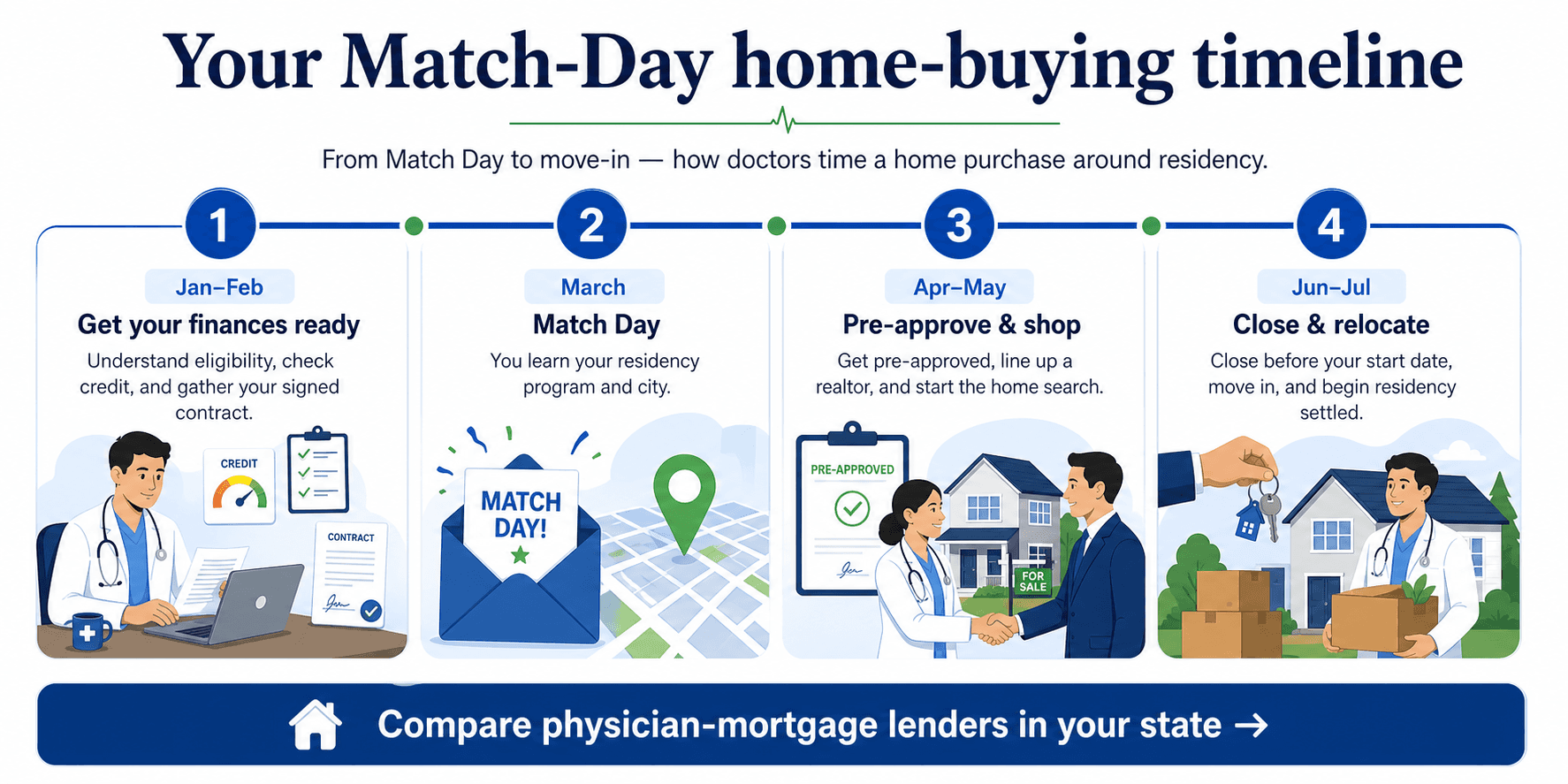
The window between signing a contract and starting a new role is often only 60 to 90 days. If you wait until two weeks before your start date to begin the mortgage process, you are almost certainly too late to close on time. Start the pre-approval process at least 60 to 90 days before you need to close.

Working with a Non-Specialist Lender

A lender who primarily handles conventional loans will not know how to underwrite a physician file. The contract-based income qualification, student loan treatment, and pre-start close timeline all require specific experience. Working with a generalist lender in a situation that requires a specialist creates friction, delays, and in some cases, approvals that fall through because the lender did not structure the file correctly from the start.

Skipping the Home Inspection

Relocating physicians sometimes waive inspections to compete in fast-moving markets or because they feel pressure to close quickly. This is particularly risky in an unfamiliar market where you have no local knowledge of building issues, neighborhood quirks, or inspection red flags. An inspection is non-negotiable, especially when buying remotely.

Underestimating Relocation Costs

The mortgage down payment and closing costs are not the only financial demands of a relocation. Budget realistically for moving company fees, state licensing application costs, utility deposits, furniture and setup expenses for a new home, and the general financial drag of a transition period. Many physicians underestimate these costs and find themselves stretched thin in the first months of a new role.

Buying Without a Budget Anchored to Real Expenses

Physician mortgage programs approve borrowers for amounts that can feel like permission to spend more than is wise. A lender approval at a 50% DTI does not mean that payment fits your actual monthly life. Run your real budget before you set your home purchase ceiling, and factor in student loan payments, retirement contributions, and the practical costs of your lifestyle.


Final Thoughts

Physicians move constantly, and the physician mortgage loan is one of the few financial products actually designed for that reality. Contract-based income qualification, no PMI, zero or low down payment options, and higher loan limits combine to make cross-state homebuying far more accessible than conventional financing allows.

The key is preparation. Start the pre-approval process early. Connect with a real estate agent in your new city before you arrive. Work with a physician mortgage lender who understands how to structure a file for a relocating doctor. And set a budget based on your actual financial picture, not just your maximum approval.

Relocation does not have to delay homeownership. With the right preparation and the right physician mortgage loan, you can close on a home, get settled, and start your new role without spending your first weeks in a hotel or short-term rental.

Disclaimer: Loan program details and terms are subject to change. All loans are subject to credit approval and underwriting guidelines. This content is for informational purposes only and does not constitute a commitment to lend.

Banner Ad