What is a Physician Mortgage?
A physician mortgage is specialized home financing created exclusively for medical professionals. Unlike traditional lenders who see a recent graduate with $300,000 in student debt as high-risk, physician mortgage lenders recognize your future earning potential and historically low default rates—doctors are six times less likely to default than average borrowers.

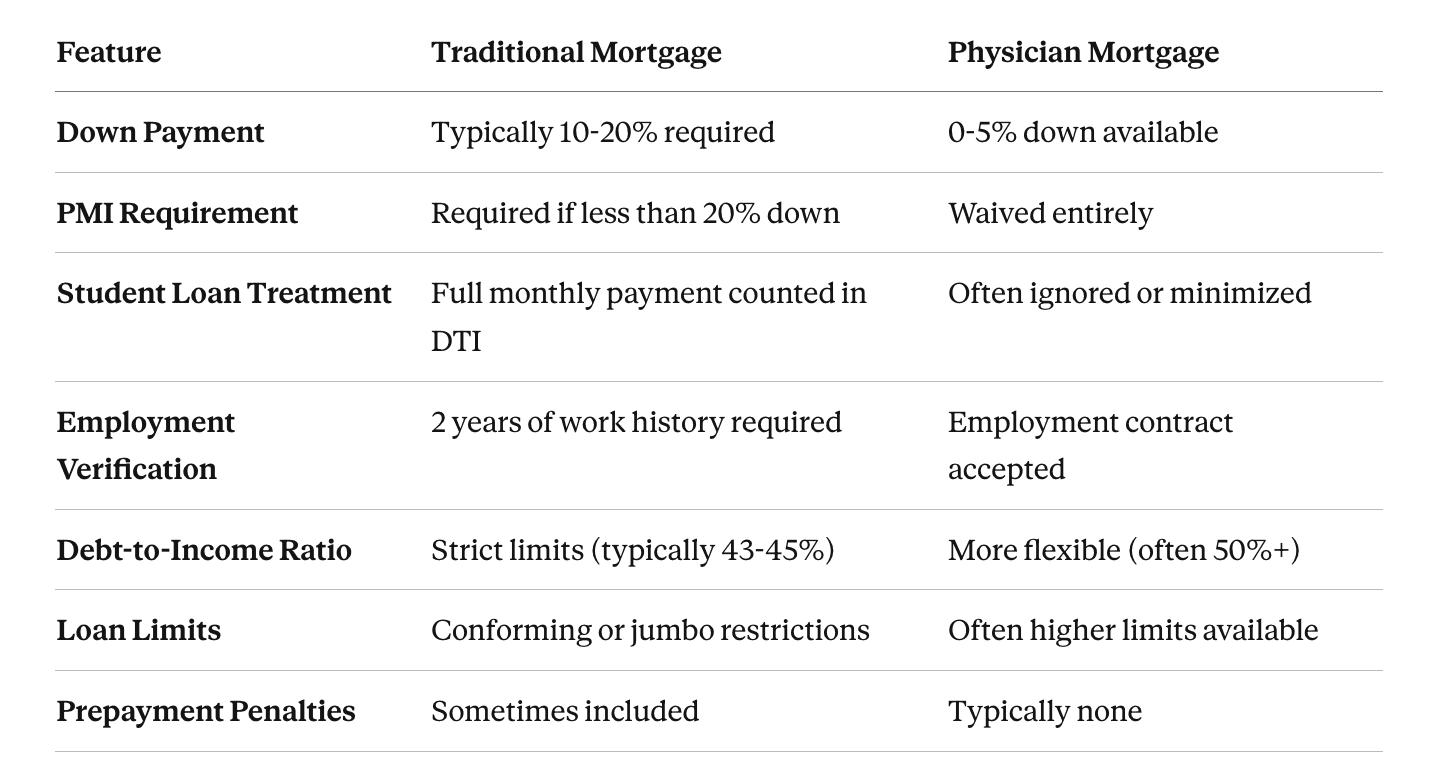
Quick Comparison
Who Qualifies for a Physician Mortgage?
Physician mortgages aren't available to everyone—lenders reserve these favorable terms for medical professionals who meet specific criteria. Understanding who qualifies helps you determine whether this loan type is right for you.
Medical Professionals Eligible
Medical doctors (MD/DO) in all specialties
Dentists (DDS/DMD)
Veterinarians (DVM)
Podiatrists (DPM)
Some advanced practitioners (varies by lender)
Chiropractor (DC)
Fellow
Intern
Nurse Anesthetist (CR/NA)
Nurse Practitioner (NP)
Occupational Therapy (OTD/MOT)
Optometrist (OD)
Pharmacist (PharmD)
Physical Therapy (DPT)
Physician Assistant (PA)
Podiatric Medicine (DPM)
Podiatrist (DPM)
Registered Nurse (RN)
Resident
Veterinarian (DVM)
Career Stage Requirements
Residents and Fellows: Many lenders work with physicians still in training, especially those within 6-12 months of completing their program.
Newly Attending: Doctors who have just finished training are prime candidates, even if they haven't received their first paycheck yet.
Established Physicians: There's often no upper limit on how long you've been practicing, though some lenders offer the best terms to physicians within their first 10 years of practice.
Practice Owners: Whether you're employed by a hospital system or own your own practice, you can typically qualify.
The Contract Advantage: If you have a signed employment contract showing your start date and salary, you can qualify even before receiving your first paycheck. This lets you close on a home before starting your new position.
Key Benefits
No Private Mortgage Insurance (PMI)
On a $500,000 loan with 5% down, PMI typically costs $4,000-$6,000 annually. That's $28,000-$42,000 over seven years—completely waived with physician mortgages.
Flexible Down Payment (0-5%)
Put down as little as zero percent while preserving cash for student loans, moving costs, or emergency funds. Many physicians choose 0-5% down even when they could afford more.
Student Loans Treated Differently
Traditional lenders might calculate a $4,000 monthly payment on your $400,000 in loans. Physician lenders use your actual payment (including $0 under income-driven plans) or ignore student loans entirely.
Competitive Rates
Despite the favorable terms, rates are competitive with traditional mortgages. Lenders view this as a long-term relationship with a high-earning professional.
Higher DTI Acceptance
Traditional mortgages cap at 43-45% debt-to-income. Physician mortgages regularly approve 50%+ because lenders understand your financial situation improves rapidly after training.
Contract-Based Approval
Use your employment contract instead of paystubs. Close before starting your attending position and move in without the stress of house hunting during your first months.
Understanding the Numbers
Loan Amounts
Most lenders offer up to $1 million with 0-5% down. Higher amounts ($1-2 million+) typically require 5-10% down. Limits vary by location and lender.
Interest Rates
Rates fluctuate with the market. Key factors affecting your rate:
Credit score (700+ preferred, 760+ for best rates)
Down payment amount
Loan size
Property type
Your lender relationship
Shop around: Rates can vary 0.25-0.5% between lenders.
The Four Cost Buckets
1. Down Payment: 0-5% of purchase price with physician mortgages
2. Closing Costs: 2-5% of purchase price including lender fees, title insurance, appraisal, inspection, and prepaid taxes/insurance
3. Monthly Payment: Principal, interest, property taxes, insurance, and HOA (if applicable). Budget $3,700-$4,500+ monthly for a $500,000 home.
4. Reserves: Keep $10,000-20,000 liquid after closing for repairs, emergencies, and moving costs.
Example Budget:
$500,000 home, 5% down
Down payment: $25,000
Closing costs: $15,000
Reserves needed: $15,000
Total cash required: $55,000
Comparing Your Options
vs. Conventional Loans
Choose physician mortgage if: You have high student debt, want to minimize down payment, need flexible DTI, or have an employment contract without work history.
Choose conventional if: You have 20% down, minimal debt, and want the absolute lowest rate.
vs. FHA Loans
FHA requires both upfront (1.75%) and monthly PMI (0.85% annually) for life of loan. On a $400,000 loan, that's $7,000 upfront plus $283/month forever. Physician mortgages eliminate all of this while offering higher loan limits.
vs. Jumbo Loans
For loans above $806,500, physician jumbo programs maintain favorable terms (low down payment, flexible DTI) that traditional jumbo loans don't offer.
Verdict: Physician mortgages are superior for most doctors in their first 10 years of practice.
The Application Process
1. Pre-Qualification (15-30 min)
Provide basic income, debt, and savings info to get a ballpark figure. No credit check required.
2. Shop Lenders (1-2 weeks)
Compare at least 3 lenders on rates, fees, terms, and service. This step saves thousands.
3. Get Pre-Approved (3-7 days)
Submit documentation for formal approval:
Employment contract or paystubs
Bank statements (2-3 months)
Student loan statements
Medical degree/license
ID and Social Security info
Your lender pulls credit and issues a pre-approval letter.
4. House Hunt (varies)
Work with a real estate agent who understands physician relocations and timelines.
5. Make an Offer (1-3 days)
Include earnest money (1-2% of price), contingencies, and proposed closing date.
6. Under Contract (2-3 weeks)
Complete home inspection, appraisal, title search, and finalize financing.
7. Underwriting (1-2 weeks)
Lender verifies all documentation. Respond promptly to any requests.
8. Closing (1-2 hours)
Sign documents, wire funds, get keys. First payment due in ~45 days.
Typical timeline: 30-45 days from offer to closing.
Common Concerns
Will my student loan debt disqualify me?
No. This is exactly why physician mortgages exist. Lenders either use your actual payment (including $0 under IBR), use a small percentage like 0.5% of balance, or exclude student loans entirely from DTI calculations.
Can I buy before starting my attending position?
Yes. With a signed employment contract showing your start date and salary (typically within 60-90 days), you can close before your first paycheck.
What if I'm still in residency without a contract?
Most lenders require a signed contract, but some work with residents 6-12 months from completion. Consider waiting for a contract or using a co-signer if you need to buy sooner.
Can I use this for rental or investment properties?
No. Physician mortgages require owner occupancy. You must live in the home as your primary residence for at least one year.
How does my credit score matter?
Most lenders want 700+, with best rates at 750+. A 60-point difference can cost 0.25-0.5% in rate—that's $27,000-$54,000 over 30 years on a $500,000 loan.
What documentation do I need?
Professional: Medical degree, license, employment contract
Income: Paystubs, W-2s (if employed)
Assets: Bank statements (2-3 months), investment accounts
Debt: Student loans, car loans, credit cards
ID: Driver's license, Social Security documentation
Will this hurt my credit?
Minimally. Multiple mortgage inquiries within 45 days count as one inquiry. Any small score drop (5-10 points) recovers within months.
Will sellers accept my offer without 20% down?
Yes. Your pre-approval letter doesn't specify down payment percentage. Sellers care about your ability to close, not your down payment size. Physicians are seen as stable, reliable buyers.
Should I buy points to lower my rate?
Usually not. Most physicians refinance within 3-5 years as income rises and debt decreases. Buying points takes 8+ years to break even, so you're better off keeping cash liquid.
Next Steps
If You're Finishing Training Within 6 Months:
Start talking to lenders now. Once you have a signed contract, get pre-approved and begin house hunting.
If You're 6-12 Months Out:
Check your credit score, address any issues, and start saving for closing costs and reserves.
If You're More Than a Year Out:
Focus on finances—pay down high-interest debt, build emergency funds, and monitor credit.
Ready to move forward?
Explore physician mortgage lenders
in your area through our comprehensive directory.
Calculate your potential savings
compared to traditional mortgages.
Read success stories
from other physicians who've used these programs.
Contact us
if you have questions or need personalized guidance.
Final Thoughts
You've invested years in medical training. You deserve a home that reflects your hard work and provides stability for the next phase of your career. Physician mortgages exist specifically to help medical professionals like you achieve homeownership despite student debt and unconventional financial profiles.
The key advantages—no PMI, low or zero down payment, favorable student loan treatment, and contract-based approval—make these loans uniquely suited to physicians at all career stages.
Take the first step today. Whether you're ready to apply or just exploring options, understanding physician mortgages puts you ahead in planning your financial future.