Physician Mortgage Loans in Atlanta, Georgia
Most physician families arriving in Atlanta are moving toward one of a handful of medical centers of gravity: the Emory campuses along Clifton Road, Grady downtown, Piedmont Atlanta in Buckhead, Northside in Sandy Springs, or a Wellstar campus out toward Cobb and North Fulton. Where you land on that map drives the school district, the commute, and the price range you end up shopping. This guide is written for the household making that decision, usually with one spouse running the move while the other finishes a residency, a fellowship, or the last months of a current job.

See poll results below
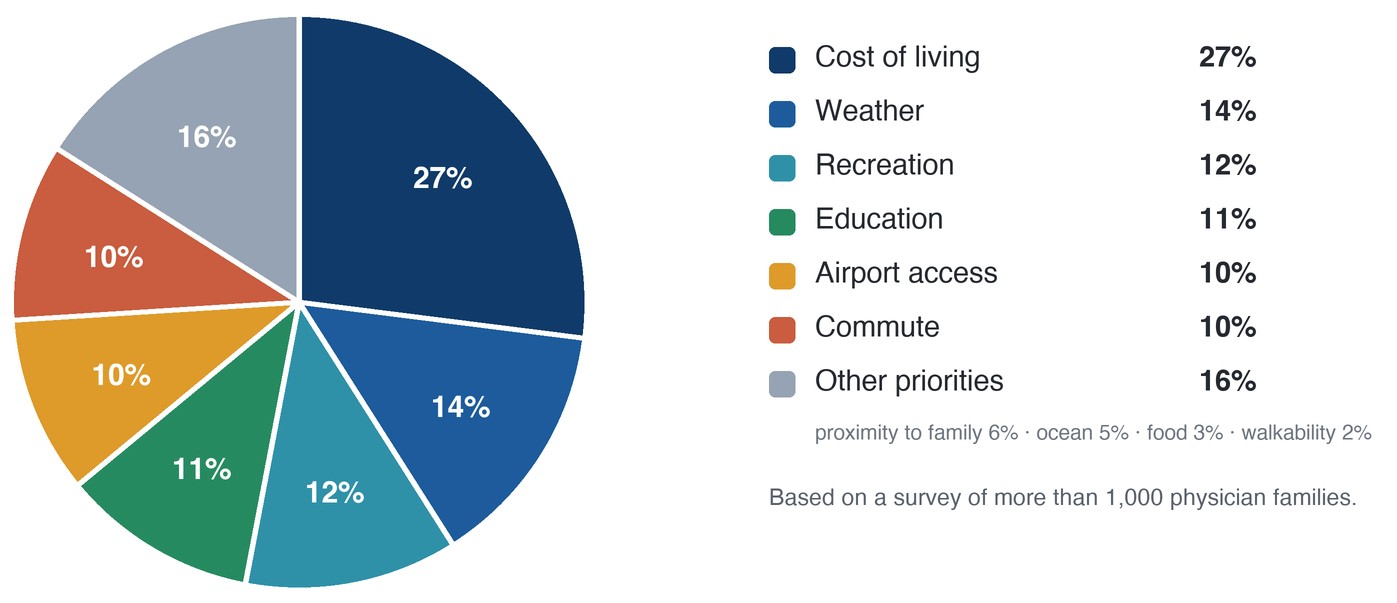
How physician families ranked their priorities
Atlanta is a hospital town before it is anything else to a physician household. Emory Healthcare, Grady Health System, Piedmont Healthcare, Northside Hospital, Wellstar, and Children's Healthcare of Atlanta anchor a metro that is also home to the Centers for Disease Control and Prevention. If you are matching, finishing a fellowship, or starting as an attending here, the real question is which side of the Perimeter your campus sits on.
In most of these moves the physician is still on service somewhere else while the spouse flies in, tours neighborhoods, and tries to line up the school calendar with the start date. Atlanta rewards that planning, because two addresses a few miles apart can produce completely different drives depending on which side of the Perimeter they sit on.
WHAT PHYSICIAN FAMILIES RANK #1 · 27%
Cost of living for a physician household
Atlanta is the reason a lot of physicians leave the coasts. An attending salary generally stretches further here than in coastal California, greater Boston, or the New York suburbs. The nuance is that intown Atlanta and the northern suburbs have both gotten more expensive, and the gap between an inside-the-Perimeter house and one in Cherokee or Forsyth County is real.
Georgia levies a flat state income tax and the legislature has been stepping the rate down. Property taxes are set at the county and city level, so identically priced homes in Fulton, DeKalb, Cobb, and Gwinnett can carry very different annual bills. Pull the real tax record on any house you are serious about, then model the payment in the physician mortgage calculator with your actual student loan number.
Where Atlanta physicians work
Emory Healthcare is the state's academic anchor and the system most incoming physicians are attached to in some form. It includes Emory University Hospital on the Clifton Road campus, Emory University Hospital Midtown, Emory Saint Joseph's in Sandy Springs, Emory Decatur, and Emory Johns Creek, plus Emory University School of Medicine and the Rollins School of Public Health. The CDC sits next door.
Grady Memorial Hospital downtown is a Level I trauma center and the city's public hospital. It is staffed by faculty and residents from both Emory University School of Medicine and Morehouse School of Medicine, which makes it the shared training floor for the city.
Beyond the academic core, Piedmont Healthcare is a nonprofit system with hospitals across Georgia, anchored by Piedmont Atlanta Hospital in Buckhead. Northside Hospital runs its flagship in Sandy Springs plus campuses in Cherokee, Forsyth, Gwinnett, and Duluth. Wellstar Health System covers the northwest side, led by Wellstar Kennestone Regional Medical Center in Marietta. Wellstar closed Atlanta Medical Center downtown in 2022, which still shapes where volume sits inside the Perimeter.
Pediatrics has its own map. Children's Healthcare of Atlanta opened the Arthur M. Blank Hospital at I-85 and North Druid Hills Road in the fall of 2024, consolidating services from the Egleston campus, and also operates Scottish Rite and Hughes Spalding. Because Atlanta is a public health capital as much as a clinical one, spouses with research backgrounds also land at the CDC, the American Cancer Society, CARE, or The Carter Center.
POLL RANK #2 · 14%
Weather and seasons
Atlanta sits in a humid subtropical climate with a long warm season and a short, mild winter. Summers are hot and humid, and the tree canopy the city is known for does real work in August. Winters stay mild enough that outdoor time is a year-round option.
Two local realities matter before you sign. Spring pollen here is legendary, so plan for it if anyone in the household has allergies or asthma. And the metro does not handle ice well. A storm that would be a nonevent in Chicago can close schools and the interstates for days, which is a real problem for the person who cannot call out.
POLL RANK #3 · 12%
Recreation and family life
The Atlanta BeltLine has changed how intown life works. It is a multi-use trail loop being built around the core of the city, and the Eastside Trail linking Piedmont Park to Ponce City Market is the stretch most people picture. If walking somewhere matters to you, the BeltLine neighborhoods and downtown Decatur are the realistic options, because most of the metro is car-dependent.
Water and mountains are close. The Chattahoochee River National Recreation Area runs in units along the river from below Buford Dam toward the city, and Lake Lanier and Lake Allatoona are the boating lakes to the north. Stone Mountain Park anchors the east side and the Blue Ridge mountains are an easy drive, but the Georgia coast is a road trip, so if the ocean is non-negotiable, know that going in.
Rainy Saturdays have the Georgia Aquarium, Zoo Atlanta, Fernbank Museum of Natural History, and the Atlanta Botanical Garden beside Piedmont Park. The food, from neighborhood restaurants intown to the Buford Highway corridor, is one of the real pleasures of living here.
POLL RANK #4 · 11%
Schools and education
Metro Atlanta is not one school system. Atlanta Public Schools covers the city proper. City Schools of Decatur is a small independent city district inside DeKalb County. DeKalb County School District, Fulton County Schools, Cobb County School District, Gwinnett County Public Schools, and Forsyth County Schools cover most of the rest.
Because attendance zones and county lines do not follow the highways, two houses a mile apart can sit in different districts with different calendars. Confirm the zone on the district website for the specific address before you offer.
Higher education is dense here too. Emory University, the Georgia Institute of Technology, and Georgia State University are all inside the city, along with the Atlanta University Center institutions: Morehouse College, Spelman College, Clark Atlanta University, and Morehouse School of Medicine.
POLL RANKS #5-6 · 10% EACH
Commutes and getting away
Traffic deserves more weight than it usually gets in a physician relocation here. The Downtown Connector, where I-75 and I-85 merge through the middle of the city, and I-285, the Perimeter loop, carry most of the metro, with GA 400 the north-south spine through Buckhead and North Fulton and I-20 running east-west. What matters is direction and timing, not distance. A longer drive in the reverse-peak direction routinely beats a shorter one in the peak direction.
MARTA rail is genuinely useful for some campuses and not others. Grady and the downtown and Midtown hospitals sit close to rail. The Emory and CDC campuses on Clifton Road are not on a rail line and rely on Clifton Corridor shuttles and MARTA bus service, with a bus rapid transit connection to Lindbergh Center under study. Drive it at the hour you would actually drive it, and drive the last mile too, because the Clifton Corridor backs up on its own schedule regardless of what the highway is doing.
The offset is Hartsfield-Jackson Atlanta International Airport, and for a physician household it is close to a decisive advantage. It is Delta's main hub, with a nonstop map that covers most of the country and a long list of international destinations. Conference travel is usually a nonstop, locums or visiting faculty work is easier to say yes to, and family in another region is reachable without a connection and a lost day. There is also a MARTA station inside the domestic terminal.
What more than 1,000 physician families told us. We surveyed more than 1,000 physician families about what matters most when choosing a new city, and cost of living came first by a wide margin, 27%, ahead of weather (14%) and recreation (12%). Atlanta is one of the few large metros where a household keeps that cost advantage and still gets a major academic system and an airport that reaches most of the country nonstop.
Financing an Atlanta home as a physician
Dr. Home Finance is a research and matching service, not a lender, a broker, or a bank. What we do is track which lenders actually serve Georgia and how their physician loan programs differ.
Lenders serving Georgia commonly offer physician mortgage programs with reduced or no down payment at certain loan amounts, and some do not require private mortgage insurance. Terms, eligible degrees, and loan limits vary from lender to lender, and every lender underwrites its own file.
Two features matter most to relocators. Some physician loan programs allow underwriting on a signed employment contract, with closing permitted around the start date, which is what makes a July start workable while you finish training elsewhere. Lenders also differ in how they treat student loan debt, with some using the income-driven repayment figure rather than a percentage of the balance.
If you are still choosing between metros, the Georgia physician mortgage guide covers statewide lender availability. When you are ready to talk to someone, you can get matched with physician mortgage lenders who write loans in Georgia and know Atlanta closing timelines.
Keep researching physician mortgages
Who qualifies — degrees, and residents vs. attendings
Student loans & how much house you can afford
The home-buying process, step by step
Do lenders offer physician mortgage loans in Atlanta?
Yes. A number of national and regional lenders serve Georgia with physician mortgage programs, and several are active specifically in metro Atlanta. Program terms differ by lender, including down payment requirements, whether private mortgage insurance is required, which degrees and specialties qualify, and maximum loan amounts. Dr. Home Finance is a research and matching service rather than a lender, so we compare those programs rather than underwrite them.
Can we close on an Atlanta home before my July start date at Emory, Grady, or Piedmont?
Often, yes. Some physician loan programs allow underwriting on a signed employment contract, with closing permitted shortly before or around the start date rather than after several pay stubs. That is what makes a summer start at an Atlanta system workable when you are finishing training in another state. Confirm the exact contract-to-close window with the lender early, because it varies and it drives your entire moving calendar.
How do I choose a location around a specific Atlanta hospital campus?
Start with the direction of your commute rather than the mileage. The Downtown Connector, I-285, and GA 400 behave very differently depending on which way you travel at peak hours, so a longer reverse-peak drive frequently beats a shorter peak-direction one. Grady and the downtown and Midtown campuses have MARTA rail access, while the Emory and CDC campuses on Clifton Road rely on shuttles and bus service. Drive the route at the hour you would actually drive it before you make an offer.
How much does Hartsfield-Jackson matter for a physician moving to Atlanta?
It is one of the practical reasons physicians take jobs here. Hartsfield-Jackson is Delta's main hub, so conference travel, locums assignments, and flights to family elsewhere are usually nonstop. It also has a MARTA rail station inside the domestic terminal. For households that will be flying regularly, that convenience is a real quality of life factor, not a footnote.