Physician Mortgage Loans in Boston, Massachusetts
Boston runs on teaching hospitals, from Mass General Brigham and Beth Israel Lahey Health to Boston Medical Center, Tufts Medicine, Boston Children's Hospital, and Dana-Farber Cancer Institute. Boston runs an unusually large number of one and two year fellowship programs, and a short training window changes the buy or rent question. This guide walks a physician household through cost of living, where the work actually sits, schools, commutes, and how physician loan availability works in Massachusetts.

See poll results below
How physician families ranked their priorities
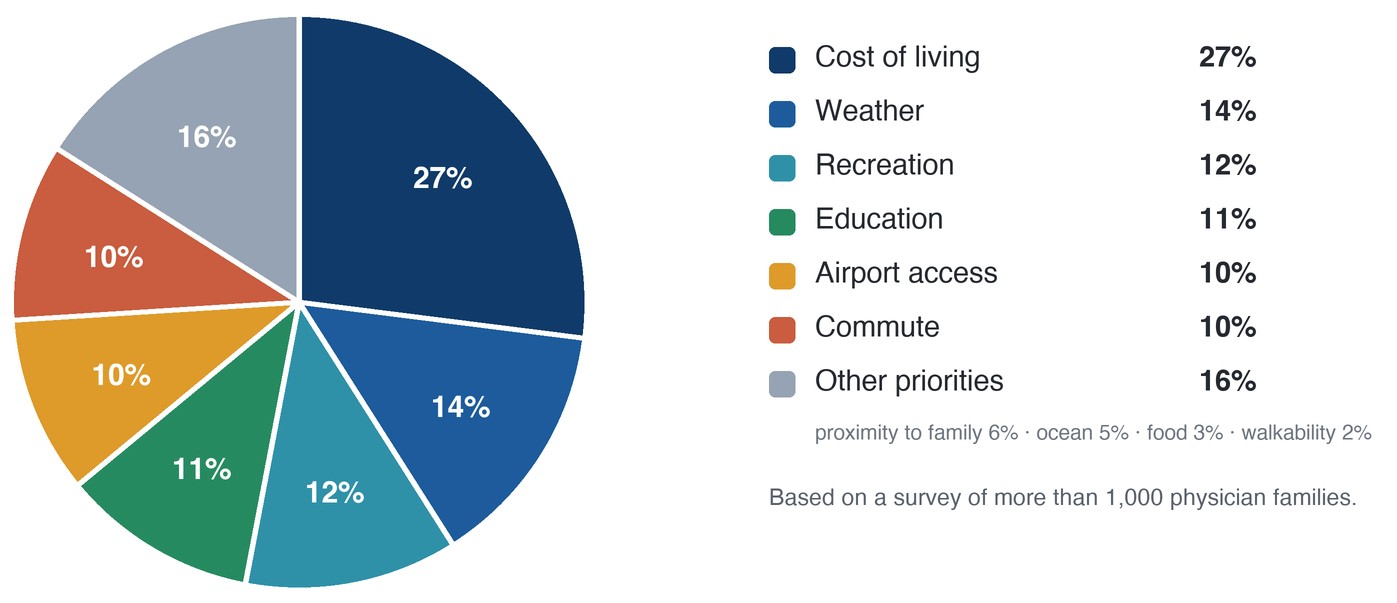
Boston is a teaching hospital town first, and a physician household feels that from the first week. Mass General Brigham, built around Massachusetts General Hospital and Brigham and Women's Hospital, sits alongside Beth Israel Lahey Health, Boston Medical Center, Tufts Medicine, Boston Children's Hospital, and Dana-Farber Cancer Institute, while Harvard Medical School, the Boston University Chobanian and Avedisian School of Medicine, and Tufts University School of Medicine train inside that same clinical map.
Boston also runs an unusually large number of one and two year fellowship programs, so a short training window is a common starting point here. That window changes the housing question, because a household that expects to move again soon weighs a purchase differently than one planting for a decade. The search usually falls to the spouse, and in this market it has to start early.
What physician families rank #1 · 27%
Cost of living for a physician household
Boston asks more of a paycheck than the Midwest and Southeast markets where a lot of physicians trained, and housing is where the gap shows. A fellowship stipend does not stretch the way it did in Ohio or the Carolinas, so the rent versus buy question is genuinely open rather than obvious.
Massachusetts charges a flat state income tax and adds a surtax on income above a high threshold that is adjusted each year, so a well paid attending or a two physician household should plan for it rather than discover it in April. Property tax is set town by town and varies widely across the metro, so two houses at the same price can carry very different payments. Condominium fees belong in that same calculation, because lenders count them in your debt ratios alongside the mortgage.
Older housing stock is the item people underestimate, since heating a century old triple decker costs real money and deferred maintenance shows up fast. Rather than guess, put a real purchase price, your student loan payment, the town tax rate, and an actual condo fee into the physician mortgage calculator, and read the Massachusetts physician mortgage guide for how lenders approach the state.
Where Boston physicians work
The Longwood Medical and Academic Area is the center of gravity. Brigham and Women's Hospital, Beth Israel Deaconess Medical Center, Boston Children's Hospital, Dana-Farber Cancer Institute, and Harvard Medical School sit within a few blocks of one another along the Boston and Brookline line, which is why housing demand in Mission Hill, the Fenway, Jamaica Plain, and Brookline moves with the academic calendar.
Downtown holds a second cluster. Massachusetts General Hospital anchors the West End along with Mass Eye and Ear, Spaulding Rehabilitation is in Charlestown, and McLean Hospital is in Belmont, all part of Mass General Brigham. Boston Medical Center sits in the South End as the primary teaching hospital for the Boston University Chobanian and Avedisian School of Medicine, and Tufts Medical Center is in Chinatown alongside Tufts University School of Medicine.
The map runs past the city limits too. Beth Israel Lahey Health includes Lahey Hospital and Medical Center in Burlington, Mount Auburn Hospital in Cambridge, and Winchester Hospital, and the VA Boston Healthcare System runs inpatient care at West Roxbury and Brockton with outpatient services in Jamaica Plain. An offer inside the metro can put you anywhere on that map, so confirm your primary campus before you commit to a town.
Poll rank #2 · 14%
Weather and seasons
New England gives you four distinct seasons, and winter is a planning variable rather than a footnote. Snow and coastal storms can slow a drive or the T on exactly the mornings you cannot be late, so households that take a lot of call often trade square footage for a shorter and more reliable trip.
Summer is warm and humid, and central air is worth confirming rather than assuming in the older triple deckers and brownstones near the hospitals. If you are looking near the harbor or on the coast, ask for the flood zone determination early, because lenders require flood insurance where FEMA maps call for it and it changes the monthly payment.
Poll rank #3 · 12%
Recreation and family life
The Emerald Necklace, the chain of parks laid out by Frederick Law Olmsted, runs from Boston Common through the Back Bay Fens and Jamaica Pond out to the Arnold Arboretum, and a good stretch of it passes within walking distance of Longwood. The Charles River Esplanade carries the running, cycling, and sailing, with Cambridge directly across the water.
Ocean access polled at 5% nationally, and Boston delivers it without a long drive. The Boston Harbor Islands, the North Shore beaches, and Cape Cod are all weekend range, while the White Mountains and the Berkshires take the hiking and ski traffic. Food and walkability polled lower, at 3% and 2%, but reaching a grocery store, a pharmacy, and a playground on foot matters when one parent works nights.
Poll rank #4 · 11%
Schools and education
Boston Public Schools does not hand out high school seats by address alone. The district runs three exam schools, Boston Latin School, Boston Latin Academy, and the John D. O'Bryant School of Mathematics and Science, which admit by application and an admissions test and require city residency. Elementary assignment follows a different process, so ask the district about a specific address rather than a neighborhood.
Households who choose a suburb are usually choosing a school system. Brookline, Newton, Lexington, and Wellesley each run their own district, with their own boundaries and enrollment calendars, and none of them follow a mailing address cleanly. Independent and parochial admissions run on early timelines, so open that conversation before the move. For a spouse finishing a degree or teaching, Harvard University, the Massachusetts Institute of Technology, Boston University, Northeastern University, and Tufts University are all inside the metro.
Poll ranks #5-6 · 10% each
Commutes and getting away
The MBTA is the commute for most physicians who live close in. The Green Line E branch stops at Longwood Medical Area, the Orange Line and commuter rail meet at Ruggles a short walk from the Longwood campuses, and the Red Line carries Cambridge and points south. Parking near the hospitals is scarce and priced accordingly, so many households treat a car as a weekend tool.
If you land in a suburb, you are choosing a commuter rail line or a highway as much as a town, with Interstate 93, the Massachusetts Turnpike, and Route 128 carrying the rest. Map the trip to your actual campus rather than to downtown in general, because the last leg between North Station or Back Bay and your hospital is the part you feel on a post call morning.
Boston Logan International Airport sits across the harbor, minutes from downtown through the tunnels or on the Blue Line, with broad domestic service and nonstop flights to Europe. For conferences, locums work, and flights home to family, that proximity is a quiet advantage of living here.
What more than 1,000 physician families told us. We surveyed more than 1,000 physician families about what matters most when choosing a new city, and cost of living came first by a wide margin, 27%, ahead of weather (14%) and recreation (12%). In Boston that ranking usually decides two things, whether a household buys at all during training and whether the search stays inside the city or moves out to a town with its own school district.
Financing a Boston home as a physician
Dr. Home Finance is a research and matching service rather than a lender, so nothing here is an offer of credit and nothing here is guaranteed. What lenders licensed in Massachusetts commonly make available to physicians is a separate question. The recurring features are a low or no down payment option, no private mortgage insurance requirement, and underwriting that treats medical student loan debt on an income driven plan differently from a conventional file. Terms differ from lender to lender, so get each one in writing.
Two Boston specifics come up in almost every conversation. The first is housing type, because a large share of the inventory near the hospitals is condominium and lenders review the association budget, reserves, owner occupancy, and any pending litigation before approving a unit. A strong borrower can still be turned down over a building, so ask about condominium eligibility early. The second is loan size, since prices here push many physician files past conforming limits and maximum loan amounts under physician programs vary widely by lender.
Contract based closing is the third question. Many lenders serving Massachusetts will underwrite on a signed employment or fellowship contract before the first pay stub, within a window they define ahead of the start date, so a purchase can close before the job begins. Bring the contract, the start date, and your student loan documentation to the first call, run the numbers in the mortgage calculator, then get matched with physician mortgage lenders serving Massachusetts.
Hero image: 4300streetcar, CC BY 4.0, via Wikimedia Commons.
Keep researching physician mortgages
Who qualifies — degrees, and residents vs. attendings
Student loans & how much house you can afford
The home-buying process, step by step
Can a physician mortgage loan be used to buy a condo in Boston?
Often, but the building matters as much as the borrower. Much of the inventory close to the Longwood Medical and Academic Area, the West End, and the South End is condominium, and lenders review the association budget, reserves, owner occupancy, and any pending litigation before they approve a unit. A strong physician file can still be declined over the building, so ask a lender about condominium eligibility before you start touring.
How does a one or two year Boston fellowship change the buy or rent decision?
It shortens the horizon, and the horizon drives the math. Boston runs an unusually large number of one and two year fellowship programs, and a short window changes the arithmetic on closing costs, resale, and how much renovation is worth taking on. Price both paths with real numbers, including the town tax rate and any condominium fee, rather than a rule of thumb.
Can I close on a Boston home before my hospital start date?
For most relocating physicians, yes. Many lenders serving Massachusetts will underwrite on a signed employment or fellowship contract before your first pay stub, within a window they define ahead of your start date. The rules vary by lender, so confirm the contract based closing policy in writing early, especially if you are moving for residency, fellowship, or a first attending job.
Which Boston hospital campuses do physician families usually build a home search around?
It depends on where your appointment sits. The Longwood Medical and Academic Area holds Brigham and Women's Hospital, Beth Israel Deaconess Medical Center, Boston Children's Hospital, Dana-Farber Cancer Institute, and Harvard Medical School. Massachusetts General Hospital and Mass Eye and Ear anchor the West End, Boston Medical Center is in the South End, and Tufts Medical Center is in Chinatown. Beth Israel Lahey Health and the VA Boston Healthcare System reach well outside the city, so confirm your primary campus before narrowing a search.