Physician Mortgage Loans in New York, New York
New York is a hospital town before it is anything else for a physician household, with NewYork-Presbyterian, NYU Langone Health, Mount Sinai, Montefiore Einstein, and NYC Health + Hospitals spread across the five boroughs. The housing decision here starts with a housing type, because co-ops, condos, and suburban houses are financed on very different terms. This guide walks a physician family through cost of living, schools, commutes, and how physician loan availability actually works in the New York market.

See poll results below
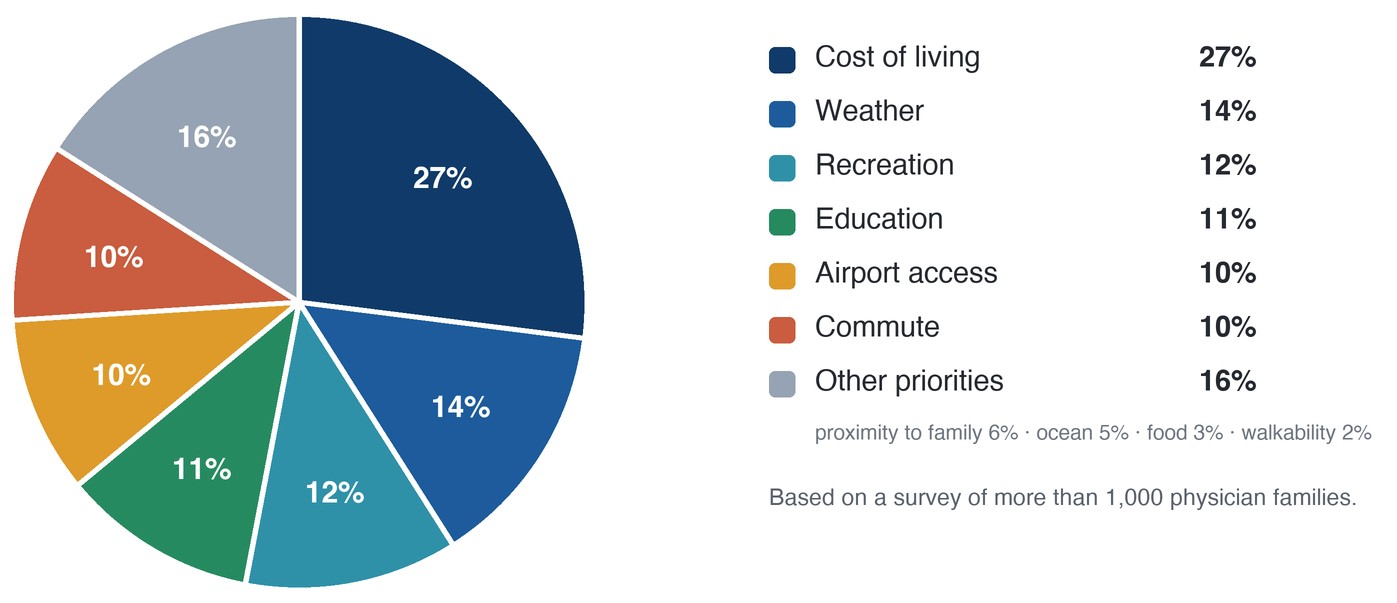
How physician families ranked their priorities
In most cities a physician home search starts with a neighborhood. In New York it starts with a housing type, because the addresses that put you near NewYork-Presbyterian, NYU Langone Health, the Mount Sinai Health System, Montefiore Einstein, Memorial Sloan Kettering Cancer Center, or the public NYC Health + Hospitals network are mostly sold as co-op shares or condo units rather than as houses. A co-op is shares in a corporation with a proprietary lease. A condo is real property. A house in Westchester, on Long Island, or in northern New Jersey is a third thing again, and lenders underwrite all three differently.
The academic side deepens the pull, with Weill Cornell Medicine, the Columbia University Vagelos College of Physicians and Surgeons, NYU Grossman School of Medicine, and the Icahn School of Medicine at Mount Sinai sending Match Day letters and fellowship offers into the same five boroughs. The search that follows usually falls to the spouse while the physician finishes a year somewhere else, and it goes better when the housing type question is settled first, because it decides which lenders are on the table at all.
WHAT PHYSICIAN FAMILIES RANK #1 · 27%
Cost of living for a physician household
Start with the honest part. New York asks more of an attending salary than the Midwest and Southeast markets where most physicians trained, and the gap shows up in housing first. A resident or fellow stipend does not stretch here the way it did in Rochester or Richmond, so plenty of training households rent for the length of the program and buy later.
Carrying cost is what surprises people. A co-op charges monthly maintenance that bundles building operating costs, the building underlying mortgage, and your share of property tax. A condo charges common charges and bills property tax separately. Lenders serving New York count those monthly charges in your debt ratios the same way they count a mortgage payment, so two apartments with identical asking prices can qualify very differently.
Residents of the five boroughs also pay a New York City personal income tax on top of state income tax, which is one reason households price out a Westchester, Long Island, or northern New Jersey address before committing to a borough. Rather than guess, put your real contract figure, your student loan payment, and a realistic maintenance or common charge into the physician mortgage calculator before you tour anything.
Where New York physicians work
Learn the clinical map early, because it drives every other decision. The Upper East Side holds NewYork-Presbyterian/Weill Cornell Medical Center, Memorial Sloan Kettering Cancer Center, the Hospital for Special Surgery, and Lenox Hill Hospital, part of Northwell Health. Uptown, NewYork-Presbyterian/Columbia University Irving Medical Center anchors Washington Heights, and on the First Avenue medical corridor in Kips Bay, NYU Langone Health and NYC Health + Hospitals/Bellevue sit a few blocks apart.
The Mount Sinai Health System runs campuses across Manhattan and into Brooklyn and Queens. In the Bronx, Montefiore Einstein pairs a large clinical system with Albert Einstein College of Medicine, and in Brooklyn, SUNY Downstate Health Sciences University is the academic center. Northwell Health extends through Queens, Staten Island, Long Island, and Westchester, so an offer inside the metro does not always mean an offer inside Manhattan. Map your campus and your call pattern before you fall in love with a listing, because a difference of a few subway stops changes what a post-call morning feels like.
POLL RANK #2 · 14%
Weather and seasons
New York gives you four real seasons. Winter brings cold stretches, snow, and nor'easters that can slow the subway for part of a day, which matters when you are the one covering the service. Summer is humid and the city holds heat, so central air is a feature to ask about in older buildings rather than assume.
Between those extremes the city is at its best, and a spring or fall walk to a campus a few blocks away is one of the real perks of living close in. The other weather item to check before you write an offer is flood risk. Parts of the Rockaways, southern Brooklyn, Staten Island, and the low-lying edges of the harbor sit in FEMA-mapped flood zones, and lenders require flood insurance where the maps call for it. Ask for the flood zone determination early, because it changes the monthly payment.
POLL RANK #3 · 12%
Recreation and family life
Central Park and Prospect Park carry daily life for a lot of physician families, and every borough has real green space, from Van Cortlandt Park in the Bronx to Flushing Meadows Corona Park in Queens. Ocean access is closer than newcomers expect. Rockaway Beach in Queens is reachable by subway and by ferry, and Jones Beach State Park sits on the south shore of Long Island. For weekends out, Bear Mountain and Harriman State Parks are a short drive up the Hudson, and the Catskills take the hiking and ski traffic.
Food and walkability polled low nationally, at 3% and 2%, but they are what New York delivers on a hospital schedule. Walking to a grocery store, a pharmacy, and a playground without moving a car is worth more than it sounds when one parent works nights and the other runs the household.
POLL RANK #4 · 11%
Schools and education
New York City Public Schools runs on an application and choice process rather than a simple address assignment, especially for middle and high school. Elementary zoning still follows address in most cases, so ask about the zoned school before you sign. The specialized high schools, including Stuyvesant High School, The Bronx High School of Science, and Brooklyn Technical High School, admit by the Specialized High Schools Admissions Test, while Fiorello H. LaGuardia High School of Music and Art and Performing Arts admits by audition.
Independent and parochial school timelines run early, so a family moving mid-cycle should open that conversation before the move. Households who choose the suburbs are usually choosing a district, and Westchester, Long Island, and northern New Jersey each contain dozens of separate districts with their own boundaries and calendars. Verify the assigned school for a specific address with the district itself. Columbia University, New York University, Fordham University, and the City University of New York campuses keep options open for a spouse finishing a degree or teaching.
POLL RANKS #5-6 · 10% EACH
Commutes and getting away
The subway is the commute for most physicians who live in the boroughs, and it runs overnight, which matters more than any drive-time estimate when you are coming off a night shift. Households that keep a car usually keep it for weekends, and garage parking is a line item to price out rather than assume.
If you land in the suburbs, you are really choosing a train line. Metro-North runs from Westchester and Connecticut into Grand Central Terminal, the Long Island Rail Road runs into Penn Station and Grand Central Madison, and NJ Transit runs into Penn Station with a PATH connection toward lower Manhattan. Map the line to your hospital campus rather than to Manhattan in general, because the last leg is the part you actually feel.
Getting out is easy from here. John F. Kennedy International and LaGuardia both sit in Queens and Newark Liberty International serves the west side of the metro, all run by the Port Authority of New York and New Jersey. Between them, almost any city hosting a major medical meeting is reachable nonstop, and so is most of the country where the rest of the family lives.
What more than 1,000 physician families told us. We surveyed more than 1,000 physician families about what matters most when choosing a new city, and cost of living came first by a wide margin, 27%, ahead of weather (14%) and recreation (12%). In New York that ranking is not close, because the cost question decides the borough, the housing type, and often whether a household buys at all during training.
Financing a New York home as a physician
Physician loan programs are available in New York, and lenders serving the state commonly offer low or no down payment options, no mortgage insurance, and underwriting that treats student loan debt on an income driven plan differently from a conventional file. Dr. Home Finance is a research and matching service rather than a lender, so these are lender programs and not ours, and terms differ by lender and change over time. Our New York physician mortgage guide covers the statewide picture.
The New York wrinkle is the housing type. Lenders underwrite co-ops differently from condos, because a co-op purchase is shares in a corporation with a proprietary lease rather than real property, and some physician loan programs limit co-ops or do not extend to them. Co-op boards separately set their own financing and reserve rules, and they run a board package and an interview on top of whatever the lender requires.
Condos and suburban single-family homes generally see the widest physician loan availability, which is why the housing type question comes first here. Prices in this metro also push many files into jumbo territory, and maximum loan amounts vary widely by lender, so compare several rather than defaulting to the bank that holds your checking account.
Relocating physicians should also ask about contract based closing. Many lenders serving New York will underwrite on a signed employment contract before the first pay stub, within a window they define ahead of the start date, so a purchase can be completed before the job begins. Run your numbers in the mortgage calculator, then get matched with physician mortgage lenders serving New York.
Hero image: Photo by Christian David, CC BY-SA 4.0, via Wikimedia Commons.
Keep researching physician mortgages
Who qualifies — degrees, and residents vs. attendings
Student loans & how much house you can afford
The home-buying process, step by step
Can a physician mortgage loan be used to buy a co-op in New York City?
Sometimes, but not always. Lenders underwrite co-ops differently from condos because you are buying shares in a corporation rather than real property, and some physician loan programs limit co-ops or do not cover them. Co-op boards also set their own financing and reserve requirements on top of the lender rules, and they run a board package and an interview. Ask about co-op eligibility before you start touring, because it narrows the lender list quickly.
What do physicians weigh when comparing the five boroughs to the suburbs?
It depends on your call schedule and on the housing type you are willing to own. Living near your campus, whether that is the Upper East Side, Washington Heights, Kips Bay, the Bronx, or Brooklyn, buys back time on call nights. Suburban towns along Metro-North, the Long Island Rail Road, and NJ Transit trade that time for space, a single assigned school district, and a different tax picture. Many physician households rent in the city during training and buy in the suburbs at the attending stage.
Can I close on a New York home before my hospital start date?
For most relocating physicians, yes. Many lenders serving New York will underwrite on a signed employment contract before your first pay stub, within a window they define ahead of your start date. The rules vary by lender, so confirm the contract based closing policy in writing early, especially if you are moving for residency, fellowship, or a first attending job.
How do maintenance fees and common charges affect what a physician can borrow in New York?
Lenders count them. Co-op maintenance and condo common charges go into your debt ratios alongside the mortgage payment and property tax, so two apartments at the same asking price can produce very different approvals. Model the actual monthly charge, not only the purchase price, when you are working out what your household can carry.