Physician Mortgage Loans in Baltimore, Maryland
Baltimore runs on two academic medical centers, Johns Hopkins Medicine in East Baltimore and the University of Maryland Medical System downtown, with MedStar Health, LifeBridge Health, and Mercy Medical Center filling in around them. Most physician households here also end up weighing Baltimore against the Washington market down the corridor. This guide covers what the metro costs a physician family, where doctors work, how city and county schools differ, commutes, and how physician loan programs are structured in Maryland.

See poll results below
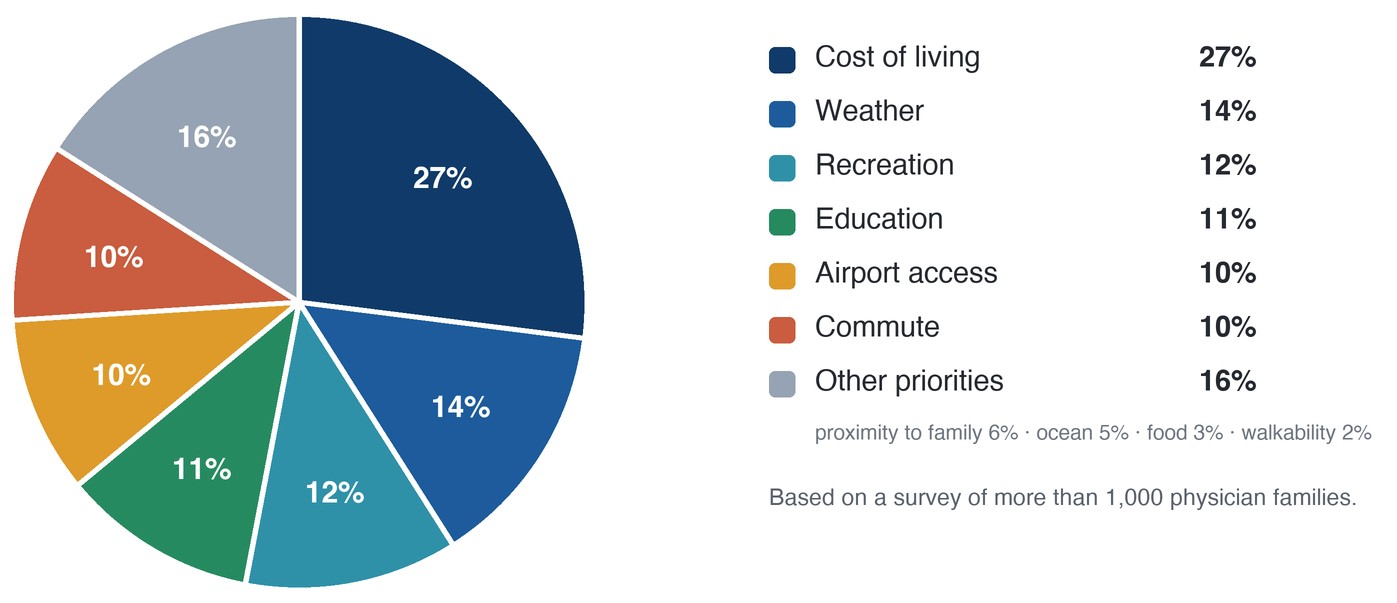
How physician families ranked their priorities
Baltimore is a two academic center city. The Johns Hopkins Hospital and the Johns Hopkins University School of Medicine sit in East Baltimore, and the University of Maryland Medical Center and the University of Maryland School of Medicine sit downtown on the west side, with the R Adams Cowley Shock Trauma Center attached. MedStar Health, LifeBridge Health, and Mercy Medical Center fill in the rest of the map.
There is a second thing almost every physician household here ends up weighing. Washington is close, and the DC side of the corridor holds the NIH Clinical Center, Walter Reed National Military Medical Center, and hospitals belonging to these same systems. Many families compare a Baltimore offer against a DC area one, and the housing math is a large part of what decides it.
What physician families rank #1 · 27%
Cost of living for a physician household
Against the Washington market, Baltimore is the more forgiving of the two for a physician household, and against the Northeast corridor generally it is more forgiving still. An attending salary reaches further here than in the DC suburbs, which is a common reason physicians who trained at Hopkins or Maryland buy on this end of the corridor.
Two Maryland specifics shape the number more than most people expect. Maryland levies a state income tax and then each county, plus Baltimore City, levies its own local income tax on top of it, so the jurisdiction you live in changes your take home pay directly. And Baltimore City's property tax rate is higher than the rates in the surrounding counties, so two comparable houses on either side of the city line can carry meaningfully different annual bills.
The practical consequence is that the city line, the county lines, and the Washington versus Baltimore question all need to be priced rather than assumed. Put the local income tax rate and the property tax bill for a specific address into the physician mortgage calculator alongside your contract income and student loan payment.
Where Baltimore physicians work
Johns Hopkins Medicine runs The Johns Hopkins Hospital and the Johns Hopkins Children's Center in East Baltimore and Johns Hopkins Bayview Medical Center in southeast Baltimore, with the school of medicine attached. The system also reaches beyond the city, including Johns Hopkins Howard County Medical Center in Columbia, Suburban Hospital in Bethesda, and Sibley Memorial Hospital in Washington, so a Hopkins appointment does not automatically mean a Baltimore address.
The University of Maryland Medical System anchors the west side with the University of Maryland Medical Center and Shock Trauma, the UM Medical Center Midtown Campus, and University of Maryland St. Joseph Medical Center in Towson, alongside the University of Maryland School of Medicine. MedStar Health runs MedStar Franklin Square Medical Center, MedStar Good Samaritan Hospital, and MedStar Harbor Hospital. LifeBridge Health runs Sinai Hospital of Baltimore, Mercy Medical Center sits downtown, and the Kennedy Krieger Institute works alongside Hopkins on pediatric neurology and developmental medicine.
One structural fact makes practicing in Maryland genuinely different. The state regulates hospital rates through a commission, so all payers pay the same rates for the same services and hospitals operate under global budgets rather than fee for service volume. It has nothing to do with your mortgage, but it shapes how systems here talk about volume, staffing, and readmissions, and it is worth understanding before you negotiate an employment agreement.
Poll rank #2 · 14%
Weather and seasons
Baltimore gets four seasons with the Chesapeake Bay moderating the edges. Summers are humid, winters are variable and swing between mild stretches and a coastal storm that shuts the schools, and spring and fall are long and pleasant. Compared with Pittsburgh or the upper Midwest, winter here asks less of you.
Two things to check before you write an offer. Water is one: waterfront and low lying properties near the harbor and the tidal creeks can sit in mapped flood zones, and lenders require flood insurance where the maps call for it. Age is the other: much of the city and the older suburbs is pre war rowhouse and bungalow stock, so budget the inspection carefully.
Poll rank #3 · 12%
Recreation and family life
Baltimore is compact, which suits a call schedule. Patterson Park and Druid Hill Park, home of the Maryland Zoo and the Rawlings Conservatory, are the big city parks, the Gwynns Falls, Jones Falls, and Herring Run greenways connect trails across the city, and the harbor promenade and Fort McHenry give you waterfront on foot.
Water is the regional recreation story. The Chesapeake Bay puts sailing, crabbing, and Annapolis within easy reach, Loch Raven Reservoir north of the city adds paddling and trail running, and the Atlantic beaches are the summer weekend. Ocean access polled at 5% and food at 3%, and between the Bay and the crab houses Baltimore delivers on both. Oriole Park at Camden Yards and M&T Bank Stadium sit side by side downtown.
Poll rank #4 · 11%
Schools and education
Baltimore City Public Schools runs a choice process for middle and high school rather than assigning every student by address, and several city high schools admit on entrance criteria, including Baltimore Polytechnic Institute and Baltimore City College. Learn the application timeline early, because it does not line up with a July hospital start date.
The surrounding county systems assign by address. Baltimore County Public Schools, the Howard County Public School System, Anne Arundel County Public Schools, and Harford County Public Schools each cover their own territory, and Howard County sits between Baltimore and Washington, which is part of why households comparing the two markets look there. Baltimore also has a long established independent school market with admissions calendars that run earlier than relocating families expect. For a spouse continuing a degree or a career, Johns Hopkins University, the University of Maryland Baltimore campus, UMBC, Towson, Loyola University Maryland, and Morgan State are all here.
Poll ranks #5-6 · 10% each
Commutes and getting away
Start with the campus. A physician at Hopkins in East Baltimore, one at the University of Maryland Medical Center downtown, and one at St. Joseph in Towson are on different sides of the same city, and I-695, the Baltimore Beltway, ties them together. I-83, the Jones Falls Expressway, feeds downtown from the north, and I-95 and the Baltimore-Washington Parkway run southwest toward Washington.
Rail is the piece that makes the Washington comparison workable. The MARC Penn Line runs from Baltimore Penn Station south to the BWI Marshall rail station and on to Washington Union Station, and Amtrak runs the same corridor faster. Inside the city, the Metro SubwayLink and Light RailLink cover specific corridors, so check whether your campus is on one before assuming you can skip the second car.
For flying, Baltimore/Washington International Thurgood Marshall Airport carries a deep domestic schedule and some international service, and the MARC and Amtrak station connects to the terminal by shuttle. Reagan National and Dulles are the alternatives on the Washington side, so conference travel and flights to family are rarely the constraint.
What more than 1,000 physician families told us. We surveyed more than 1,000 physician families about what matters most when choosing a new city, and cost of living came first by a wide margin, 27%, ahead of weather (14%) and recreation (12%). In this corridor that ranking is the whole Baltimore versus Washington conversation, because the clinical opportunities on both ends are strong and the housing and tax math is what differs.
Financing a Baltimore home as a physician
Dr. Home Finance is a research and matching service rather than a lender, so nothing below is an offer from us. It is what lenders active in Maryland commonly do, and what to confirm in writing.
Lenders serving Maryland often extend physician mortgage programs to residents, fellows, and practicing attendings. The recurring features are low or no down payment, no private mortgage insurance requirement, and underwriting that treats medical student loan debt differently than a conventional file, often by counting an income driven repayment amount rather than a percentage of the balance. Eligibility and documentation vary by lender, so ask rather than assume.
If you are comparing Baltimore against the Washington side, price both with the same lender rather than in isolation. Loan limits differ by county and the DC area counties push more purchases into jumbo territory, so ask each lender where their physician program stops and whether a jumbo version exists. Ask about property type too, since city rowhouses, condos, and multi unit properties are not always treated like a detached suburban house.
Relocating physicians should ask about contract based closing, because many lenders will underwrite a signed employment contract as qualifying income and allow a closing shortly before a July start date. Model a payment with the mortgage calculator, read the statewide view in the Maryland physician mortgage guide, and when you are ready to talk to someone, get matched with physician mortgage lenders who work the Baltimore market.
Hero image: Quintin Soloviev, CC BY 4.0, via Wikimedia Commons.
Keep researching physician mortgages
Who qualifies — degrees, and residents vs. attendings
Student loans & how much house you can afford
The home-buying process, step by step
Are physician mortgage loans available in Baltimore?
Yes. Lenders active in Maryland commonly offer physician mortgage programs to residents, fellows, and practicing attendings buying in Baltimore and the surrounding counties, typically with low or no down payment and no private mortgage insurance requirement. Dr. Home Finance is a research and matching service rather than a lender, so terms, eligibility, and pricing always come from the lender you work with.
How should a physician compare buying in Baltimore against the Washington area?
Price both with the same lender rather than in isolation. Maryland levies a state income tax and each county plus Baltimore City levies its own local income tax, so take home pay changes with the jurisdiction. Conforming loan limits also differ by county, and the Washington area counties push more purchases into jumbo territory. Ask each lender where their physician program stops, whether a jumbo version exists, and how the two payments compare on the same income.
Why do property tax bills differ so much between Baltimore City and the surrounding counties?
Rates are set separately. Baltimore City's property tax rate is higher than the rates in the surrounding Maryland counties, so two comparable houses on either side of the city line can carry meaningfully different annual bills. Ask for the actual current tax bill on any specific property rather than estimating from the purchase price, and include it when you model the monthly payment.
Can I close on a Baltimore home before my hospital start date?
Often yes. Many lenders serving Maryland will underwrite a signed employment contract as qualifying income and allow a closing shortly before your start date, which helps physicians relocating to Johns Hopkins Medicine, the University of Maryland Medical System, MedStar Health, or LifeBridge Health for a July start. The allowed window varies by lender, so confirm the policy in writing before you make an offer.