Physician Mortgage Loans in Philadelphia, Pennsylvania
Philadelphia trains physicians at five medical schools inside the city, and the teaching hospitals run from Penn Medicine and Children's Hospital of Philadelphia in University City to Jefferson Health in Center City and Temple Health to the north. Most physician households arrive for residency or fellowship, so the buy decision often comes up while the training is still running. This guide covers what the metro costs a physician family, where doctors work, how city and suburban schools differ, and how physician loan programs are structured in Pennsylvania.

See poll results below
How physician families ranked their priorities
Philadelphia is a training town. Penn Medicine, Jefferson Health, Temple Health, and Children's Hospital of Philadelphia sit within a few miles of one another, and five medical schools train physicians inside the city: Penn, Jefferson, Temple, Drexel, and the Philadelphia College of Osteopathic Medicine. Philadelphia trains an unusually large share of its own physician workforce, so many households face the buy decision while still in training.
That pattern shapes the housing question in a specific way. In coastal markets a trainee rents and hopes. Here, buying during training or right at the first attending job is realistic for many households, which means the mortgage conversation starts years earlier than it would in New York or California. This guide is written for the person actually running the move, usually the spouse, while the physician finishes a year somewhere else.
What physician families rank #1 · 27%
Cost of living for a physician household
Philadelphia is the rare large Northeast metro where an attending salary still buys a real house. It costs more than the Midwest and far less than the New York metro or coastal California, and the housing stock is unusually varied, from Center City rowhouses and condos to suburban lots in Montgomery, Delaware, Chester, and Bucks counties and across the river in South Jersey.
Two tax facts drive real decisions. Pennsylvania levies a flat state income tax rather than graduated brackets, which favors a high physician income. Philadelphia separately levies a wage tax on residents and, at a different rate, on nonresidents who work in the city, so where you live and where your hospital sits both matter to take home pay. Property tax is set locally, so bills vary sharply from one township or district to the next.
The constraint for most physicians here is not the price of a house, it is the down payment and the student loan balance on the application. That is the gap physician loan programs were built to close. Run your real numbers, including the loan payment, through the physician mortgage calculator before you decide to rent for the length of the program.
Where Philadelphia physicians work
University City holds the largest single cluster. Penn Medicine runs the Hospital of the University of Pennsylvania and Penn Presbyterian Medical Center there, and Pennsylvania Hospital in Society Hill, with the Perelman School of Medicine attached. Children's Hospital of Philadelphia sits on the same campus, and the Corporal Michael J. Crescenz VA Medical Center is a short distance away in West Philadelphia.
In Center City, Jefferson Health runs Thomas Jefferson University Hospital alongside the Sidney Kimmel Medical College. Wills Eye Hospital, a specialty ophthalmology hospital, is also in Center City. Jefferson also operates Jefferson Einstein Philadelphia Hospital in North Philadelphia following the Einstein Healthcare Network combination.
North Philadelphia is Temple's territory, with Temple University Hospital, the Lewis Katz School of Medicine, and Fox Chase Cancer Center in the Northeast. St. Christopher's Hospital for Children, owned by Tower Health and Drexel University, is the other pediatric teaching hospital in North Philadelphia. Drexel University College of Medicine and the Philadelphia College of Osteopathic Medicine add two more physician pipelines to the city, and across the Delaware River in Camden, Cooper University Health Care pairs with Cooper Medical School of Rowan University. In the western suburbs, Main Line Health runs Lankenau Medical Center, Bryn Mawr Hospital, Paoli Hospital, and Riddle Hospital.
Practically, that density means job changes inside the metro often do not require a move, and a two physician couple has a real chance of both matching in the same city.
Poll rank #2 · 14%
Weather and seasons
Philadelphia gives you four real seasons. Summers are humid, winters swing between mild weeks and a coastal storm that closes schools, and spring and fall are the payoff. If you are arriving from Florida or Texas, budget for winter clothing and a plan for snow days.
The practical item to check before you write an offer is water. Older rowhouse stock, finished basements, and properties near the Schuylkill, the Delaware, or a creek can carry flood exposure, and lenders require flood insurance where the maps call for it. Ask for the flood zone determination early, because it changes the monthly payment.
Poll rank #3 · 12%
Recreation and family life
Philadelphia is a good city for people with irregular hours, because so much of it is close in. Fairmount Park runs along the Schuylkill with Boathouse Row and the Philadelphia Museum of Art at its edge, the Schuylkill River Trail carries runners and cyclists out through the western suburbs, and Wissahickon Valley Park holds miles of wooded trail along Forbidden Drive.
The cultural stack is deep, including the Barnes Foundation, the Franklin Institute, and the sports complex in South Philadelphia. Food polled at only 3% nationally, but Reading Terminal Market and the Italian Market are part of daily life here rather than a tourist stop. Walkability polled at 2% and Center City delivers it. For weekends, Valley Forge National Historical Park, the Poconos, and the New Jersey shore are all drivable.
Poll rank #4 · 11%
Schools and education
The School District of Philadelphia runs neighborhood schools by catchment plus criteria based schools that admit through an application and lottery, including Central High School and Julia R. Masterman. Those rules have changed several times in recent years, so check the current process for the year you are applying.
The suburbs work the opposite way and assign by address, which is why so many attending families end up choosing a district before a house. Lower Merion, Radnor Township, Tredyffrin-Easttown, Upper Dublin, and Wallingford-Swarthmore each run their own district, with firm boundaries that do not follow mailing addresses. The region also has a long independent and Friends school tradition with early admissions calendars, so start that conversation early. For a spouse continuing a degree, the University of Pennsylvania, Drexel, Temple, Villanova, Saint Joseph's University, Swarthmore, Haverford, and Bryn Mawr College are all inside the metro.
Poll ranks #5-6 · 10% each
Commutes and getting away
Answer the campus question before the house hunt. A physician at Penn or CHOP in University City, one at Jefferson in Center City, and one at Temple in North Philadelphia are on different transit lines and different highways, and the Schuylkill Expressway between them is the road everyone complains about.
SEPTA is the lever most households underuse. Regional Rail runs from the suburbs into 30th Street Station, Suburban Station, and Jefferson Station, the Market-Frankford Line serves University City, and the Broad Street Line runs to Temple. Choosing a suburb here means choosing a rail line, so map it to your campus rather than to Center City in general. I-476, the Blue Route, and I-95 carry the rest, and PATCO connects South Jersey.
Getting away is one of this city's quiet advantages. Philadelphia International Airport has a large domestic schedule plus international service, and SEPTA runs to it. For conferences, the Amtrak Northeast Corridor from William H. Gray III 30th Street Station puts New York and Washington within a train ride.
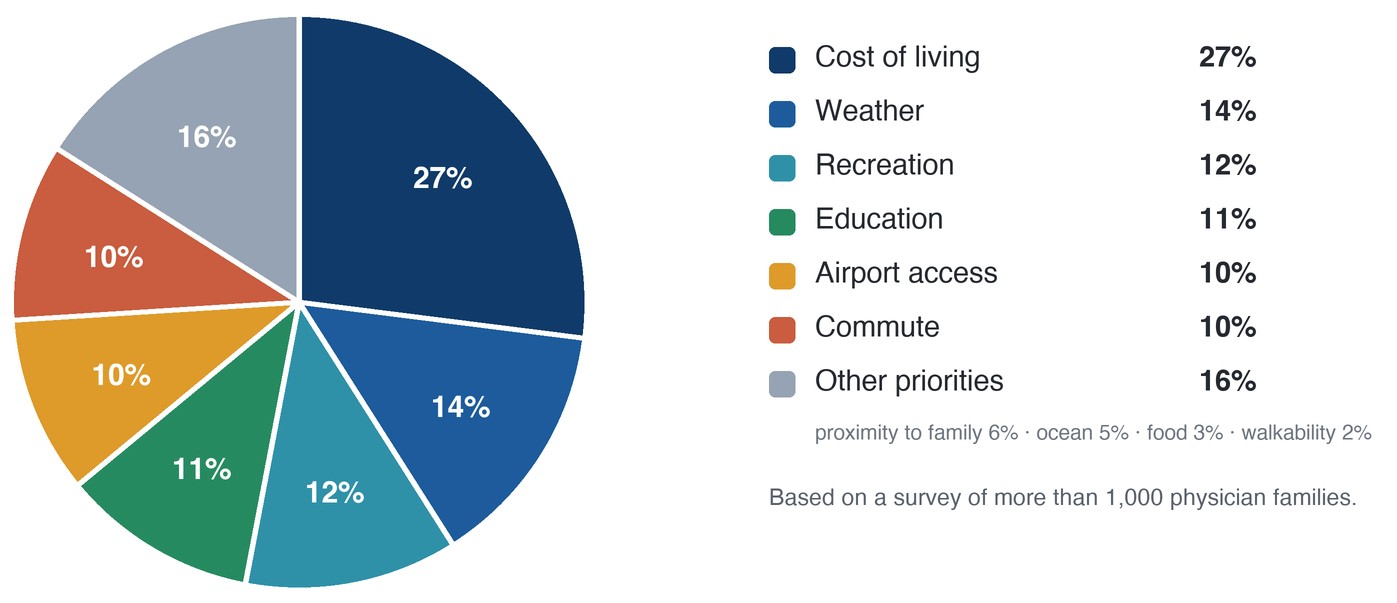
What more than 1,000 physician families told us. We surveyed more than 1,000 physician families about what matters most when choosing a new city, and cost of living came first by a wide margin, 27%, ahead of weather (14%) and recreation (12%). Philadelphia is one of the metros where that first factor is less of a constraint than in the other large Northeast markets.
Financing a Philadelphia home as a physician
Dr. Home Finance is a research and matching service rather than a lender, so nothing below is an offer from us. It is what lenders active in Pennsylvania commonly do, and what to confirm in writing with each one.
Lenders serving Pennsylvania often extend physician mortgage programs to residents, fellows, and practicing attendings. The recurring features are low or no down payment, no private mortgage insurance requirement, and underwriting that treats medical student loan debt differently than a conventional file, for example by counting an income driven repayment amount rather than a percentage of the balance. Eligibility and documentation vary by lender, so ask rather than assume.
Two things come up repeatedly here. Because so many buyers are still in training, ask each lender which stages they will lend to and what income they will use, since resident and fellow programs are not identical to attending programs. And if you are looking at a Center City condo or a converted rowhouse, ask whether the property type is eligible, because condo project rules narrow the lender list quickly.
Relocating physicians should also ask about contract based closing, since many lenders will underwrite a signed employment contract as qualifying income and allow a closing shortly before the start date. Model a payment with the mortgage calculator, read the statewide view in the Pennsylvania physician mortgage guide, and when you are ready for real offers, get matched with physician loan officers who work the Philadelphia market.
Hero image: 颐园居, CC BY-SA 4.0, via Wikimedia Commons.
Keep researching physician mortgages
Who qualifies — degrees, and residents vs. attendings
Student loans & how much house you can afford
The home-buying process, step by step
Other physician-mortgage metros in Pennsylvania
Comparing offers across Pennsylvania? Doctors relocating within the state often weigh more than one metro. Explore physician mortgage guidance in nearby Pennsylvania cities:
Can a resident or fellow in Philadelphia get a physician mortgage loan?
Frequently yes. Lenders serving Pennsylvania commonly extend physician mortgage programs to residents and fellows as well as practicing attendings, often with low or no down payment and no private mortgage insurance requirement. Program terms for trainees are not always identical to attending terms, so ask each lender which training stages they cover and what income they will use. Dr. Home Finance is a research and matching service rather than a lender, so terms always come from the lender.
Does the Philadelphia city wage tax affect where physicians choose to live?
It is part of the calculation. Philadelphia levies a wage tax on people who live in the city and, at a different rate, on nonresidents who work in the city, and Pennsylvania levies a flat state income tax on top of that. Because property tax is also set locally, the same household income can produce different take home pay and different monthly bills depending on which city or township you buy in. Work it through with your own numbers before you narrow the search.
Can I buy in Philadelphia before my residency or hospital start date?
Often yes. Many lenders serving Pennsylvania will underwrite a signed employment or training contract as qualifying income and allow a closing shortly before the start date, which helps physicians relocating to Penn Medicine, Jefferson Health, Temple Health, Children's Hospital of Philadelphia, or a suburban system. The allowed window varies by lender, so confirm it in writing before you make an offer.
How do Philadelphia city schools and suburban school districts differ for a relocating family?
They work differently. The School District of Philadelphia runs neighborhood schools by catchment plus criteria based schools such as Central High School and Julia R. Masterman that admit through an application and lottery process whose rules have changed several times in recent years. Suburban districts including Lower Merion, Radnor Township, and Tredyffrin-Easttown assign by address with firm boundaries. Confirm the assignment for a specific address with the district itself rather than a listing site.