Physician Mortgage Loans in Pittsburgh, Pennsylvania
Pittsburgh medicine centers on Oakland, where UPMC and the University of Pittsburgh School of Medicine sit alongside UPMC Presbyterian, Magee-Womens, and the VA Pittsburgh campus, with UPMC Children's Hospital of Pittsburgh in nearby Lawrenceville and Allegheny Health Network anchoring the North Side. Housing costs here are far gentler than the eastern side of the state, which changes what a physician household can do. This guide covers cost of living, where doctors work, school districts, commutes, and how physician loan programs are structured in Pennsylvania.

See poll results below
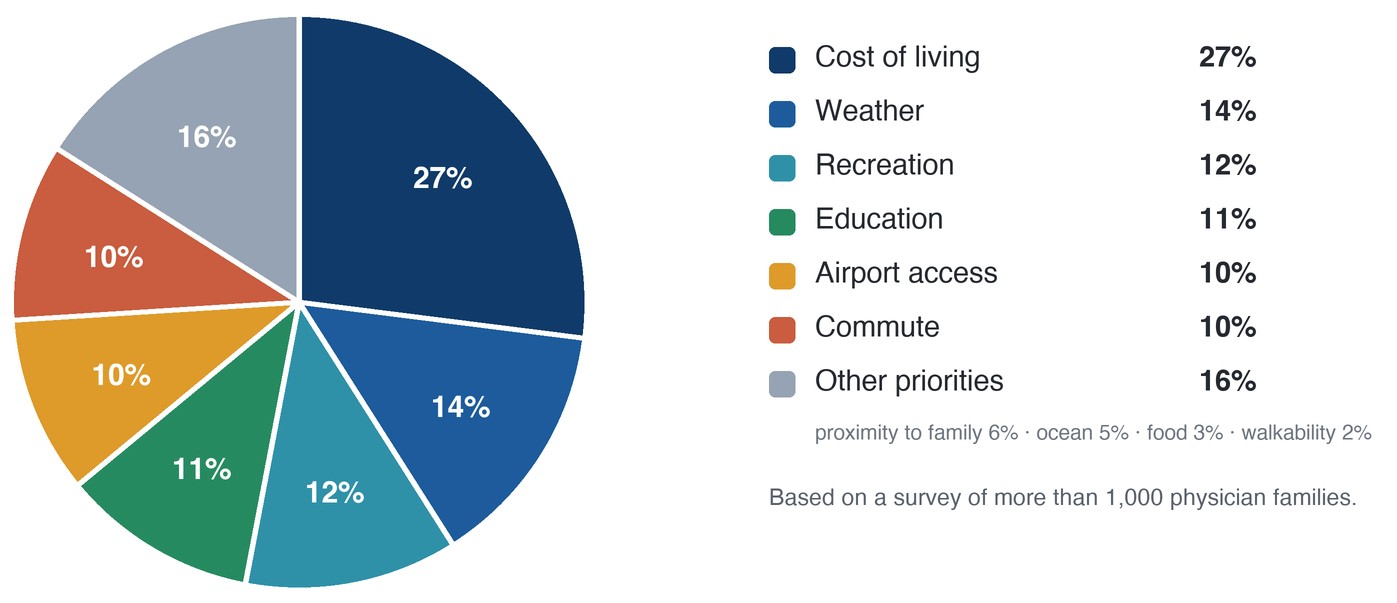
How physician families ranked their priorities
Pittsburgh medicine has a center of gravity, and it is Oakland. UPMC and the University of Pittsburgh School of Medicine sit a few blocks apart there, with UPMC Presbyterian, UPMC Magee-Womens Hospital, and the VA Pittsburgh Healthcare System campus all inside the same neighborhood, and UPMC Children's Hospital of Pittsburgh about two miles northeast in Lawrenceville. Allegheny Health Network, the second system, anchors the North Side at Allegheny General Hospital.
The other thing to know before you look at a single listing is that Pittsburgh housing costs are gentler than the eastern side of Pennsylvania, and dramatically gentler than the coastal metros where many physicians train. That changes the whole relocation, so this guide spends less time on surviving the market and more on choosing well inside it.
What physician families rank #1 · 27%
Cost of living for a physician household
For a physician household, Pittsburgh is one of the easier landings in the country. An attending salary here buys a house on real land inside a named suburban district, without the compromises the same salary forces in Philadelphia, Boston, or coastal California. Buying during training is a realistic option here in a way it is not in most large metros.
Two structural facts still deserve attention. Pennsylvania levies a flat state income tax rather than a graduated one, which suits a high physician income, and municipalities and school districts levy local earned income taxes on top of it, so take home pay shifts depending on where you live. Property tax is assessed by Allegheny County and then levied separately by the municipality and the school district, so two similar houses a few miles apart can carry very different annual bills. Ask for the actual tax bill on any property you are serious about.
The older housing stock is the other thing to budget for. Much of the city and the inner suburbs is pre war and built on hillsides, and it comes with the inspection list that implies: roofs, drainage, knob and tube wiring, retaining walls. Run a payment that includes taxes, insurance, and a maintenance reserve through the physician mortgage calculator rather than a price alone.
Where Pittsburgh physicians work
UPMC dominates. It runs UPMC Presbyterian and UPMC Montefiore in Oakland, UPMC Shadyside, UPMC Magee-Womens Hospital, UPMC Children's Hospital of Pittsburgh in Lawrenceville, UPMC Mercy, and community hospitals including UPMC Passavant in the North Hills and UPMC St. Margaret, and the academic training runs through the University of Pittsburgh School of Medicine. The VA Pittsburgh Healthcare System campus on University Drive in Oakland is affiliated with Pitt and trains residents and students.
Allegheny Health Network is the counterweight. Owned by Highmark, AHN runs Allegheny General Hospital as its academic flagship along with West Penn Hospital in Bloomfield and community hospitals including Forbes Hospital in Monroeville and Jefferson Hospital in Jefferson Hills, and it serves as a clinical campus for Drexel University College of Medicine and the Lake Erie College of Osteopathic Medicine.
Something unusual follows from that structure. Both dominant systems are paired with an insurer, UPMC with its own health plan and AHN with Highmark, so provider and payer are vertically integrated on both sides. That does not change your mortgage, but it shapes contracting and referral patterns, so understand it before you sign an employment agreement.
The wider economy also matters to a spouse's job search. The University of Pittsburgh, Carnegie Mellon University, and Duquesne University sit inside the city, and the robotics, software, and life sciences employers around them drive much of the region's hiring.
Poll rank #2 · 14%
Weather and seasons
Pittsburgh has four honest seasons, and winter is the one to plan for. Expect cold stretches, snow, and cloudy days between late fall and early spring. Summers are warm and humid, and spring and fall are genuinely good.
The local wrinkle is topography. A steep street that is charming in June is a different proposition on an icy morning when you are due for an early case, so drive the route to the hospital rather than trusting the map, and ask about drainage and hillside stability on sloped lots.
Poll rank #3 · 12%
Recreation and family life
The park system is the underrated part of living here. Frick Park and Schenley Park sit inside the city with real woodland trails, Point State Park marks the confluence of the three rivers, and the Three Rivers Heritage Trail runs along the water. The Great Allegheny Passage begins in Pittsburgh and runs to Cumberland, Maryland.
Southeast of the city, Ohiopyle State Park and the Laurel Highlands cover whitewater, climbing, hiking, and skiing, and Frank Lloyd Wright's Fallingwater sits in the same corner of the state. In the city, the Carnegie Museums, the Andy Warhol Museum, and Phipps Conservatory carry the cultural side, with PNC Park, Acrisure Stadium, and PPG Paints Arena for the rest. Walkability polled at 2%, and here it is neighborhood scale rather than citywide, real in places like Squirrel Hill, Shadyside, and Lawrenceville.
Poll rank #4 · 11%
Schools and education
Allegheny County is divided into a large number of small school districts, which is the first thing for a relocating family to understand. Pittsburgh Public Schools covers the city and runs magnet programs with their own application process, while the suburbs are a patchwork of independent districts that assign by address.
Mt. Lebanon and Upper St. Clair in the South Hills, North Allegheny and Pine-Richland in the north, and Fox Chapel Area to the northeast each run their own district, with their own boundaries and enrollment calendars. Because district lines here do not follow municipal names or mailing addresses cleanly, confirm the assignment for an exact address with the district itself before you make an offer. For a spouse continuing a degree or teaching, Pitt, Carnegie Mellon, and Duquesne are all in the city.
Poll ranks #5-6 · 10% each
Commutes and getting away
Rivers and hills mean Pittsburgh has fewer alternate routes than a flat grid city, so the tunnels and bridges do the work. I-376, the Parkway East, carries traffic from the eastern suburbs through the Squirrel Hill Tunnel toward Oakland and downtown, the Parkway West runs through the Fort Pitt Tunnel toward the airport, and I-279, the Parkway North, serves the North Hills. When one of them backs up, there is often no clean way around it.
That is exactly why the campus question comes first. A physician at UPMC Presbyterian in Oakland, one at Allegheny General on the North Side, and one at Forbes Hospital in Monroeville should not be shopping the same suburbs. Pittsburgh Regional Transit runs light rail, the T, from the South Hills into downtown along with dedicated busways.
Pittsburgh International Airport opened an entirely new landside terminal in 2025. It is an origin and destination airport rather than a connecting hub now, with a solid domestic schedule and a small amount of transatlantic service, so most conference travel and most flights home are one connection at worst.
What more than 1,000 physician families told us. We surveyed more than 1,000 physician families about what matters most when choosing a new city, and cost of living came first by a wide margin, 27%, ahead of weather (14%) and recreation (12%). Pittsburgh is one of the few large medical markets where that first factor stops being a constraint, which frees a household to choose on schools, commute, and the house itself.
Financing a Pittsburgh home as a physician
At Dr. Home Finance we compare physician mortgage programs and hand households to the loan officers who run them. We do not lend, underwrite, or price anything, so read what follows as a description of what lenders licensed in Pennsylvania make available, and confirm every line of it in writing. Those lenders frequently write physician programs for residents, fellows, and attendings. Expect a small or zero down payment, no private mortgage insurance requirement, and student loan treatment that departs from conventional underwriting, often by using an income driven payment in place of a percentage of the balance. None of it is standardized.
In this market the questions skew differently than they do on the coasts. Jumbo limits rarely bind here, so the more useful questions are which training stages a lender will approve, how they treat a first year attending with no pay history, and whether the older housing stock you are shopping raises any appraisal or condition issues. If you are buying a pre war house, ask early what the lender expects on inspection findings.
If your start date is still ahead of you, raise contract based qualifying on the first call, because a signed employment contract can often stand in for pay stubs and let a closing land before day one. Test a payment in the mortgage calculator, take the wider view in the Pennsylvania physician mortgage guide, and when you want offers side by side, get matched with physician loan officers who work the Pittsburgh market.
Keep researching physician mortgages
Who qualifies — degrees, and residents vs. attendings
Student loans & how much house you can afford
The home-buying process, step by step
Other physician-mortgage metros in Pennsylvania
Comparing offers across Pennsylvania? Doctors relocating within the state often weigh more than one metro. Explore physician mortgage guidance in nearby Pennsylvania cities:
Are physician mortgage loans available in Pittsburgh?
Yes. Lenders active in Pennsylvania commonly offer physician mortgage programs to residents, fellows, and practicing attendings buying in the Pittsburgh area, typically with low or no down payment and no private mortgage insurance requirement. Dr. Home Finance is a research and matching service rather than a lender, so terms, eligibility, and pricing always come from the lender you work with.
Can a resident or fellow realistically buy a home in Pittsburgh?
More often than in most large medical markets. Pittsburgh housing costs are gentler than the eastern side of Pennsylvania and than the coastal metros, so buying during training is a real option for many households rather than a stretch. It still depends on your down payment, your student loan payment, and how long you expect to stay, so run the numbers before you decide, and ask each lender which training stages their physician program covers.
How do property taxes work for a physician buying in the Pittsburgh area?
Property is assessed by Allegheny County, and then the municipality and the school district each levy their own rate on that assessment. That means two similar houses a few miles apart can carry noticeably different annual bills. Ask for the actual current tax bill on any property you are serious about rather than estimating from the purchase price.
How do school districts work for a family relocating to the Pittsburgh area?
Allegheny County is divided into a large number of small districts, so the district line matters more than the municipal name or the mailing address. Pittsburgh Public Schools covers the city and runs magnet programs with their own application process. In the suburbs, Mt. Lebanon and Upper St. Clair in the South Hills, North Allegheny and Pine-Richland in the north, and Fox Chapel Area to the northeast each run their own district, with their own boundaries and enrollment calendars. Confirm the assignment for an exact address with the district before you make an offer.