Physician Mortgage Loans in San Francisco, California
San Francisco is a UCSF town first, with Zuckerberg San Francisco General, the San Francisco VA, Kaiser Permanente, California Pacific Medical Center, and Stanford Health Care down the peninsula filling in the rest of the map. It is also the most demanding housing market a physician household is likely to face, where even an attending salary gets stretched. This guide covers cost of living, where doctors work, schools, the city versus peninsula versus East Bay decision, and how physician loan programs are structured in California.

See poll results below
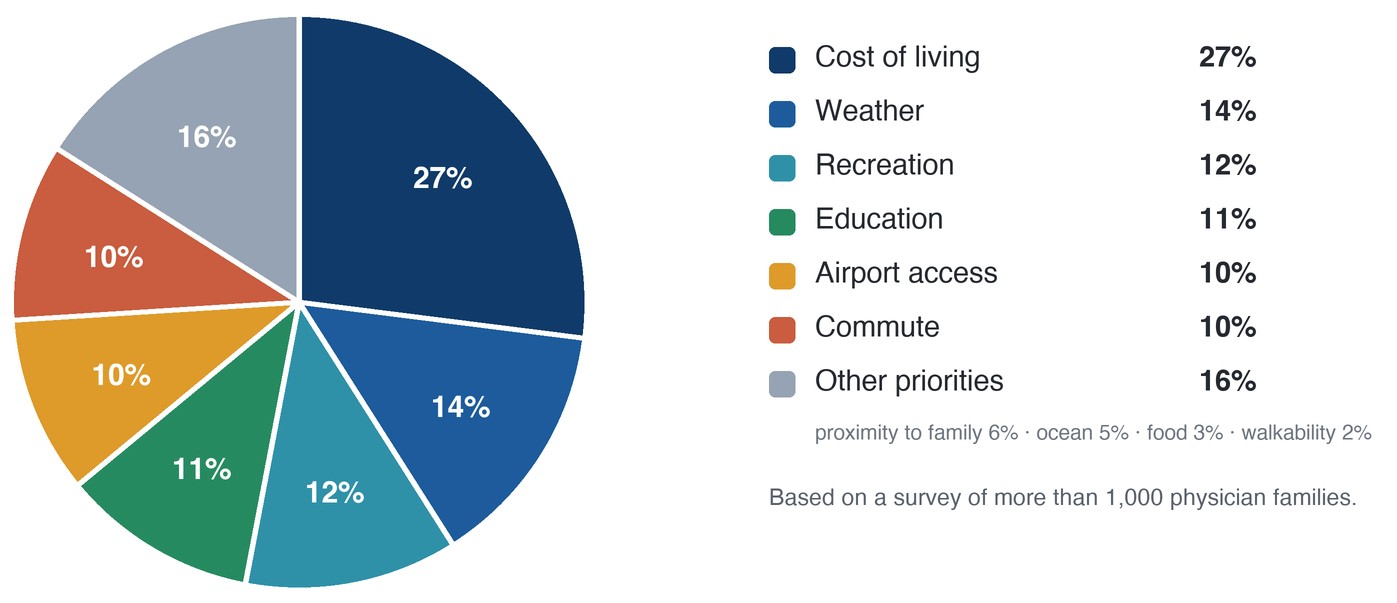
How physician families ranked their priorities
Physician households do not move to San Francisco for San Francisco. They move because a match, a fellowship, or a first attending contract landed at UCSF Health, Zuckerberg San Francisco General Hospital and Trauma Center, the San Francisco VA Health Care System, Kaiser Permanente or California Pacific Medical Center in the city, or Stanford Health Care down the peninsula. That one badge sets the commute, the school question, and the price range, usually in that order.
The physician is rarely the one running this search. The doctor is finishing a year somewhere else while the spouse works out how a hospital job in an exceptionally expensive market turns into an address. This guide is for that person, and it is blunt about the money.
What physician families rank #1 · 27%
Cost of living for a physician household
San Francisco strains an attending salary, not just a resident stipend. Physicians who trained in the Midwest or the Southeast are used to being the highest earner in the room, and here a two income household in tech or biotech can outbid a single physician income.
Three structural facts shape the arithmetic. California income tax is graduated, and an attending salary sits in its upper brackets, which is why take home pay trails the offer letter. Proposition 13 ties your assessment to the price on your own closing statement, so it resets when you buy and your future neighbor's bill is no guide at all. Earthquake coverage is not part of a standard California homeowners policy, so if you want it you buy it separately.
What stops most doctors here is not the size of the salary. It is having the down payment liquid on the day an offer is due, in the same month a cross country move is being paid for. That gap is what physician loan programs were built to close, and a high program ceiling and no private mortgage insurance requirement matter far more here than in a market where a resident could save a down payment. Run your contract figure and your real student loan payment through the physician mortgage calculator before you tour anything.
Where San Francisco physicians work
UCSF is the gravitational center. UCSF Health runs medical centers at Parnassus Heights, Mission Bay, and Mount Zion, and Mission Bay holds UCSF Bakar Cancer Hospital, UCSF Benioff Children's Hospital San Francisco, and the UCSF Betty Irene Moore Women's Hospital beside a large research campus. UCSF is a health sciences university with no undergraduate college.
Two UCSF affiliated sites carry much of the training. Zuckerberg San Francisco General Hospital and Trauma Center is the city and county's trauma and psychiatric emergency provider and one of UCSF's primary teaching hospitals. The San Francisco VA Health Care System at Fort Miley is integrated with UCSF closely enough that physicians are recruited jointly.
On the private side, California Pacific Medical Center is Sutter Health's San Francisco presence, Kaiser Permanente operates a San Francisco medical center, and Chinese Hospital remains independent in Chinatown. UCSF Health also reaches past its own campuses: it acquired the former Saint Francis Memorial Hospital and St. Mary's Medical Center from Dignity Health in 2024 and renamed them UCSF Health Hyde Hospital and UCSF Health Stanyan Hospital in 2025. Stanford Health Care and Lucile Packard Children's Hospital Stanford sit in Palo Alto with the Stanford University School of Medicine, and across the bay are UCSF Benioff Children's Hospital Oakland, Kaiser Permanente Oakland, Alta Bates Summit Medical Center, and Highland Hospital.
Mission Bay and the South San Francisco biotech corridor employ a large research and clinical development workforce, so a spouse with a science or engineering background has real options here.
Poll rank #2 · 14%
Weather and seasons
San Francisco does not have the weather people picture when they hear California. Summers in the city are cool and often foggy, winters mild and wet, and the warm stretch shows up in September and October.
Microclimate is the operative word. The Sunset and Richmond districts sit under fog that the Mission and Potrero Hill frequently miss, and the peninsula and inland East Bay run warmer and sunnier. Many older homes here were built without air conditioning. Seismic exposure is the other item to settle before you write an offer, since retrofit status and earthquake coverage are separate line items from the loan.
Poll rank #3 · 12%
Recreation and family life
This is where the metro earns back some of what it charges. Golden Gate Park, the Presidio, Lands End, Crissy Field, and Ocean Beach are inside city limits, so a physician coming off a night can be under trees soon after leaving the hospital. Mount Tamalpais State Park, Muir Woods National Monument, and Point Reyes National Seashore are day trip range across the bridge.
Ocean access polled at 5%, and here it is scenery and surfing rather than swimming, because the water stays cold. Lake Tahoe is the winter weekend, Napa and Sonoma the other direction. Food polled at 3% and walkability at 2%, but San Francisco is one of the few American cities where a household can run daily life on foot and on Muni, which counts for more when one parent works nights.
Poll rank #4 · 11%
Schools and education
San Francisco Unified School District does not assign students to a school purely by address. Families apply and rank choices, and placement runs through a citywide process with tiebreakers, so buying near a particular school does not guarantee a seat in it. Understand that before you choose a neighborhood rather than after.
Independent school admissions calendars run earlier than relocating families expect, so open that conversation early. Outside the city the districts are conventional and address based, including Palo Alto Unified near Stanford, San Mateo Union and Sequoia Union high school districts on the peninsula, and Berkeley Unified in the East Bay. Confirm the assignment for an exact address with the district enrollment office. For a spouse continuing a career or a degree, Stanford, UC Berkeley, UCSF, San Francisco State University, and the University of San Francisco sit inside the commute shed.
Poll ranks #5-6 · 10% each
Commutes and getting away
City versus peninsula versus East Bay is the defining housing decision here, and where you round should answer it. A physician at Parnassus or Mission Bay who lives in the city can often walk, bike, or ride Muni Metro. The same physician in Marin crosses the Golden Gate Bridge every shift, on the peninsula uses US 101, I-280, or Caltrain, and in the East Bay uses BART or the Bay Bridge.
Flip the job and the answer flips with it. An attending at Stanford Health Care who lives in San Francisco runs a reverse commute many households find workable, while the same trip southbound in the morning peak is not. Caltrain runs electric trains on the peninsula corridor and BART links the city to the East Bay, so a family hoping to avoid a second car should check whether the hospital campus is near a station.
Getting out is straightforward. San Francisco International Airport carries a deep domestic schedule and extensive international service, and the Oakland airport and San Jose Mineta International Airport are often faster to reach depending on which side of the water you settle. Conference travel and flights home are rarely the hard part.
What more than 1,000 physician families told us. We surveyed more than 1,000 physician families about what matters most when choosing a new city, and cost of living came first by a wide margin, 27%, ahead of weather (14%) and recreation (12%). In San Francisco that ranking is not abstract, because the housing number decides which side of the bay you live on and whether you buy during training at all.
Financing a San Francisco home as a physician
Dr. Home Finance researches physician mortgage programs and introduces households to the loan officers who run them. We are not a lender, so what follows describes the California market rather than an offer. Lenders here commonly open physician programs to residents, fellows, and attendings, and the features that recur are a small or zero down payment, no private mortgage insurance requirement, and student loan underwriting that can use an income driven payment instead of a percentage of the balance. Every one of those varies by lender.
Two details carry extra weight here. San Francisco County carries a high cost area conforming limit, and a large share of local purchases clear it anyway, so make each lender state its program ceiling and what happens above it. And raise contract based closing early, because a signed employment contract can often stand in for pay stubs and let a closing land shortly before the start date.
Price a payment in the mortgage calculator, take the statewide view in the California physician mortgage guide, and when you want actual offers, get matched with physician loan officers who work the San Francisco market.
Keep researching physician mortgages
Who qualifies — degrees, and residents vs. attendings
Student loans & how much house you can afford
The home-buying process, step by step
Other physician-mortgage metros in California
Comparing offers across California? Doctors relocating within the state often weigh more than one metro. Explore physician mortgage guidance in nearby California cities:
Physician mortgages in Los Angeles, CA · Physician mortgages in San Diego, CA · Physician mortgages in Sacramento, CA
Are physician mortgage loans available in San Francisco?
Yes. Lenders licensed in California commonly extend physician mortgage programs to residents, fellows, and practicing attendings buying in San Francisco and the surrounding Bay Area, usually with a small or zero down payment and no private mortgage insurance requirement. Dr. Home Finance researches those programs and introduces you to the loan officers who run them, and we do not lend, so every term and every eligibility rule belongs to the lender.
Where does a physician loan program stop working for San Francisco prices?
That line moves depending on which side of the county line you shop. Purchases inside the city and on the mid peninsula near Stanford sit at the top of the local range, while parts of the far south peninsula and the East Bay come in lower, so the same physician program can cover a purchase in one and fall short in another. San Francisco County carries a high cost area conforming limit and plenty of purchases clear it anyway. Ask each lender where its physician program caps out, whether a jumbo version exists, and what changes above that line, because the answer helps decide which side of the bay you shop.
Should a physician live in San Francisco, on the peninsula, or in the East Bay?
It depends on which campus you report to and how often. A physician at UCSF Parnassus or Mission Bay who lives in the city can often use Muni Metro or a bike, while living in Marin means the Golden Gate Bridge, the peninsula means US 101, I-280, or Caltrain, and the East Bay means BART or the Bay Bridge. An attending at Stanford Health Care in Palo Alto faces the reverse pattern. Map your campus and your call schedule before you shop, because the same house is a different commute depending on where you work.
Can I close on a San Francisco home before my hospital start date?
Often yes. Many lenders serving California will underwrite a signed employment contract as qualifying income and allow a closing shortly before your start date, which helps physicians relocating for residency, fellowship, or a first attending job at UCSF, Zuckerberg San Francisco General, the San Francisco VA, or Stanford Health Care. The allowed window varies by lender, so confirm the policy in writing before you write an offer.